
I’d heard the Midwest was flat. That driving through it would be boring, with not much to see.
Last month I left Prescott at six in the morning for the Prairie Festival at the Land Institute in Salina, Kansas. Somewhere between the feedlots, grain elevators, roadside sculptures and a loaf of bread, I found plenty to think about.
I’ve followed the institute’s work since Tim and Sarah Crews left Prescott around 2012. Tim’s teaching in agroecology at Prescott College helped shape people who continue to feed our community. Sarah’s work helping people navigate death also left roots here. Their move gave me a personal connection to a place asking a question that matters to anyone who eats: Can we grow our staple crops differently?
Founded in the 1970s by Wes and Dana Jackson, the Land Institute works to develop perennial grain and oilseed crops. Instead of planting every year, farmers could harvest plants that keep growing for several seasons, leaving their roots in the ground and disturbing the soil less.
But first, I had to get to Kansas.
Beyond Flagstaff, pine forest gave way to red and gray stone. Freight trains rolled alongside the highway like mile-long centipedes. I spent the night in Tucumcari, then headed northeast before sunrise.
Across Texas and Oklahoma, I passed vast expanses of crowded, manure-muddied feedlots that saddened me to think about the animals that suffer there — and strengthened my resolve to keep buying beef from Leslie at L-Bell Ranch.
The prairie itself was beautiful. Small towns appeared around grain elevators and water towers. Some looked busy, others nearly deserted.
Then in Mullinville, Kansas I spotted a peculiar crop in the distance. Not wheat, corn or sorghum, but metal sculptures. A sign pointed to the MT Liggett Art Environment.
An art environment? I turned off the highway.
I found welded figures and whirligigs, many delivering pointed political opinions. Liggett had transformed the roadside into an outdoor world of his own making, an “art environment” where the setting becomes part of the artwork. I learned there were others across Kansas, places shaped by people whose creativity spilled into their yards and landscapes.
So much for boring.
At the Land Institute, nestled among rolling hills outside Salina, I collected my registration badge prominently announcing that this was my first Prairie Festival.
I didn’t know anyone. At community meals, I had to come out of my shell, find a seat and introduce myself.
“What do you grow?”
“What brought you here?”
Those questions opened conversations with farmers, scientists, longtime supporters and former interns. I met a couple who had left firefighting jobs in Colorado to start a regenerative farm in Michigan. I also met energy writer Amory Lovins and became a little starstruck.
“I read your books in college — especially Brittle Power!” He was not impressed.
Lectures and research-plot tours explored the challenges of growing food in an increasingly less predictable climate. That uncertainty felt familiar.
When we started growing on our Prescott property, Delicious Earth Farm, twelve years ago, spring generally brought cool weather and moisture from spring snow melt. I could count on apples and peaches more reliably. Last year early warmth caused early bud break, followed by a killing frost. The monsoons have become uncertain, while fall brought exceptional rain.
Growing food has always involved weather. Planning around it feels harder.
Perennial crops offer one possible tool. Keeping living roots in place can protect soil, support underground life, and reduce the need for repeated tillage. Developing plants that also produce dependable harvests takes years of patient breeding and fieldwork.
One crop from the institute already reaching kitchens is Kernza™, a grain harvested from intermediate wheatgrass. Originally grown as forage for livestock, this perennial relative of wheat returns year after year, developing deep roots that help hold soil in place. Land Institute researchers have selectively bred it for larger seeds and better grain yields, making it useful as food for people, too. Ground into flour, Kernza can be blended with wheat flour for bread, pasta and other foods.
The meals brought the research to the table: perennial grains in pizza, sandwiches and pasta with Kernza beer, and vodka, too.
At Delicious Earth we’re experimenting with Kernza and silphium, a perennial sunflower being developed as an oilseed crop.
Our Kernza grows along a swale berm, where the shape of the land captures runoff. It’s beginning to spread by sending out seed. The silphium grows beside a greenhouse, receiving water from its roof and providing summer flowers for bees and other visitors.
We don’t have enough space to harvest meaningful quantities of grain or oilseed. But tending these plants gives me a way to observe the possibilities in our own soil and climate. And I can bake.
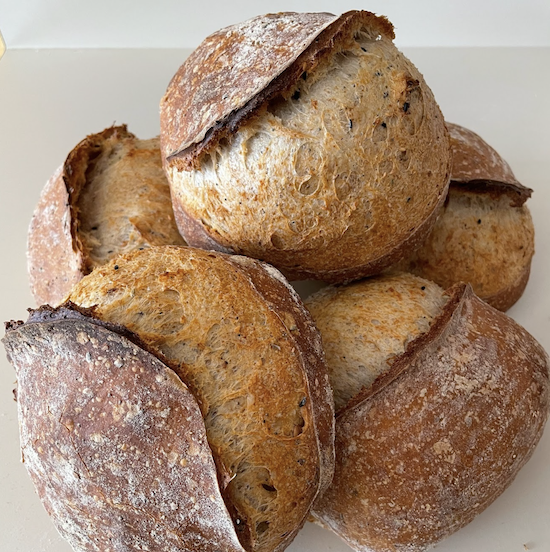
I bought Kernza flour and substituted it for the freshly ground Red Fife whole-wheat flour I normally use in one of our bread batches. My customers enjoyed the nutty, flavorful loaf.
On the festival’s final morning, after a Kernza pancake breakfast and the closing talks, one thought stayed with me: “We’re only temporarily not soil.”
I thought about that on the drive home. The ground beneath us feeds us, and eventually we return to it. Tending it felt like a responsibility that extended well beyond a growing season.
Crossing New Mexico and Arizona, I drove through a major rainstorm. The washes I’d passed so many times, always dry and dusty, were flowing. I had wondered whether I would ever see water in them. Now, from the highway, I could see it reaching the edges of buildings.
I came home to Prescott, where I’ve put down roots and planted my life with Delisa. There are fruits, vegetables, chickens and art to watch, bread to bake, and land and relationships to tend. Here at Delicious Earth Farm and Bakery, I’ll keep growing what I can and feeding the people around me.
There had been plenty to see on the road to Salina. Plenty to pay attention to back home, too. What do you grow?
Chef Molly Beverly is away. Earl PN Duque operates Delicious Earth Farm and is a member of Slow Food Prescott. Photo (and bread) by Earl.
Chef Molly Beverly is Prescott's leading creative food activist and teacher. Photos by Gary Beverly.


