
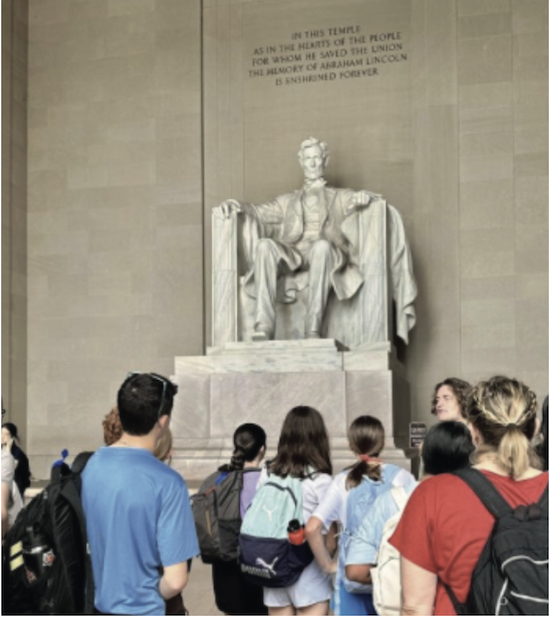
I live far from DC. I’m across the country in Prescott, a place of western landscapes and a pioneer past. Here our monuments are a statue of a cowboy on a horse and a thumb-shaped mountain outcrop. I'll add that our stately white courthouse is impressive and could be called a monument, too.
The monuments that we hold in reverence are mostly in DC, that center of American government, with its history of our nation made visible in its statues and buildings.
In some ways, my American patriotism rises from those images in our capital: the Lincoln Memorial, the White House, the towering Washington obelisk with its glowing reflection pool. A few of the government buildings, too, have historical importance and stand as monuments. To visit them all up close, maybe with a group of sixth-graders, is a way of taking our history seriously.
Like the Statue of Liberty, the monuments and buildings of DC are images that stand for American values — our treasured freedoms, our respect for the rule of law, our dreams o possibilities for all. We see in those silent stone monuments a vision of who we are, as if they bring our heritage into reality. We need them to remind us of our unique identity.
They seem to say, “We are heroic. We are solid and permanent. We have defended personal freedom for all individuals, regardless of color or creed. We have struggled to remain true to our founding documents and overcome challenges to our dream of liberty for everyone, and we will be here forever.”
So my despair at the physical changes in DC, instituted by our President, comes from a sense that we are losing touch with a principled center, a decent place I can look to for honorable leadership. Indeed, the paving over of the Rose Garden seemed to start the ruin of respected, even fragile, traditions that should be preserved.
For example, the East Wing of the White House is being expensively reshaped to accommodate a 90,000-square-foot ballroom. Like the Versailles palace of Louis XIV, it will be a place of parties and gatherings of the privileged. I can imagine the dresses and the chandeliers. I’d rather not.
The White House is owned by us, the citizens who look at that building as a symbol of integrity and honor, a center of American identity. It should be a place of thoughtful decision-making, of earnest judgment rather than a gathering of party-goers.
In addition, I’ve learned that our President wants to cover the statues in DC in gold. Am I living in a storybook tale of emperors? Will the modest beauty of our stately center of government turn into Oz? It seems to me that we want a place that reflects our diverse peoples, our love of freedom. It needs to be sober, varied, interesting — and attractive, not garish.
How would I redesign Washington if I had that power? I’d find the most brilliant civic engineers and designers in America and ask them for their ideas, as we did for the Vietnam Memorial. I’d expect their designs to be creative yet sober, fitting to the task of renewing our center of government with dignity and beauty.
We already have a hall of statues dedicated to representations of each state. National Statuary Hall is one of the most popular rooms in the Capitol. Its collection of statuary is visited by thousands of tourists each day, including schoolchildren, and continues to be used for ceremonial occasions. Those monuments seem an appropriate way to honor our various, complicated, enormous country.
If we want to make changes in DC, I think we need to take the time to do it right, not with golden statues or a huge arch of triumph. We are more than our heroes, or great wealth, or victorious armies. We are a collection of various peoples, of different land‐scapes, and myriad ideas. I like the word‘diversity’ as an apt description of our identity.
Our seat of government must be more reflective of that wide variety of our land and peoples. We’ve come through a civil war, a desperate depression, dangerous strife in our streets over civil rights, and we still struggle in a war of ideas as we come to a time of elections. The miracle is that we seem to be able to gather under one flag.
Our monuments should make us proud of our complicated past. More than towering statues, monuments could be dedicated gardens; they could be exciting buildings that house American art; they could be centers of exploration and learning. They should be beautiful enough to make those sixth-graders stand in awe.
Elaine Jordan, author of Mrs. Ogg Played the Harp, is a local editor who’s lived in Prescott for thirty years.


