
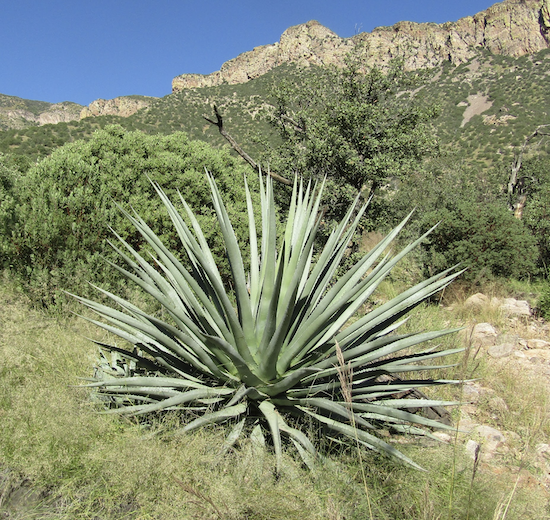
Miller Canyon Trail #106, in the Miller Peak Wilderness, is about as far south as you can hike in Arizona without going into Mexico.
The Miller Peak Wilderness is on the border, and we were about 15 miles from it. This is part of the Arizona Trail. For those going north it’s the trail’s first leg; for those headed south, it’s last.
This 7.1-mile trail climbs 2,839 feet in the Coronado National Forest. It connects with the Crest Trail that goes to the top of Miller Peak. With the range of elevation, it offers a lot of terrain diversity.
Large trees offer a lot of shade, fortunately, including Arizona sycamore, Douglas fir and big maples.
Miller Canyon Trail goes through a riparian area with a few creek crossings, and there are remnants of old mining sites. A bit more than a mile up the trail we came to the mining community of Palmerlee, where remnants of one of its buildings remain. There are also many caves near the trail.
The views are spectacular: San Pedro Valley, Mule Mountain and Miller Peak.
Miller Canyon Trail 106 wanders through habitat for many reptiles and small mammals, but it’s best known for its birds, particularly hummingbirds, including Anna’s, broad-chinned, broad-billed, rufous and black-chinned varieties.
We saw an abundance of butterflies. Joining me on this hike was veteran hiker Karen Flynn and my Preserving Arizona Wilderness videographer Titian Beltran. I chose Karen as our guest interviewer because she knows the terrain and history of Miller Peak Wilderness. She is also a land steward for the first stretch of the Arizona Trail. Our video will be on our website in about a month.
The birds are spectacular, way too many to list, but it’s a special treat is if you see a flame-colored tanager or an eared quetzal. You may also see an array of woodpeckers, including Arizona woodpecker, northern flicker, hairy and acorn woodpeckers.
Miller Peak Wilderness encompasses 20,190 acres and was established in 1984, a land of sheer cliffs, soaring summits and deep canyons. Among these diverse life zones lives an amazing variety of wildlife, including over 170 bird species, 14 of them hummingbirds, and 78 species of mammals, including coatimundi, javelina, black bear and mountain lion. Over 60 species of reptiles are here as well.
Seventeenth-century Spanish Captain Juan Mateo Manje referred to these mountains in his expedition journal as Sierra de Huachuca, or Huachuca Mountains, the name most likely taken after a nearby Pima village.
Once cloaked in pines and firs, fires have converted much of this area to predominantly oak and grass vegetation, with mixed conifer and aspen stands at higher elevations.
At least 21 trails lead through the Wilderness from its eastern, western and southern boundaries. The Crest Trail (11.5 miles) climbs from 5,200 feet to as high as 9,466 feet at the apex of Miller Peak.
The Huachucas are rich in history. These canyons, cliffs and forests are littered with the remains of various late 19th- and early 20th-century mining booms that all eventually went bust. Today that gold rush has been replaced with a recreation rush.
Like many wilderness areas, Miller Peak Wilderness has been affected by fire. The 2011 Monument Fire took out most of the pines, and scrub oaks are beginning to fill in those areas.
Wilderness areas are designated by Congress and protected from development and motorized vehicles. Each is special in its own way, ranging from desert to high mountains, offering all sorts of hiking, nature photography and birding among their recreational attractions.
The US Forest Service, Bureau of Land Management and National Park Service are responsible for protecting these wilderness areas. Non-governmental groups like Wild Arizona and the Sierra Club help.
Presenting at NHI
I’ll be doing a presentation about the beauty of Granite Mountain, honoring the Granite Mountain Hot Shots and other firefighters who protect wilderness areas. I’ll show short videos: two about Granite Mountain and one about the fire in Bear Wallow Wilderness that started when someone left a candy wrapper in a campfire. Please join me at 7 pm November 5 at the Natural History Institute, 126 N. Marina St in Prescott.
Stan Bindell is always looking for a good hike. If you have one, contact him at thebluesmagician@gmail. com


