
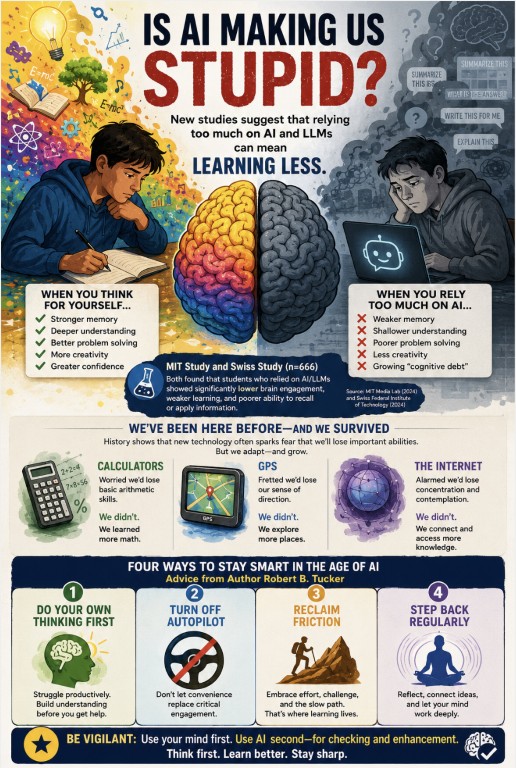
IT’S OFFICIAL: reliance on AI to write and solve problems can be harmful to your reasoning powers. Multiple studies have come to the same conclusions, but the most recent ones released in May and June are even clearer.
The largest study, conducted by the University of Pennsylvania’s Wharton School, involved 4,500 participants who used LLMs and Google Search. The study examined the cognitive differences between two groups and found that people who used chatbots had “shallower knowledge” of what they were asked to research than the Google Search subjects. For instance, when the groups were asked to research how to start a vegetable garden, the AI users gave worse advice in their essays than those who used the search engine. Their depth of knowledge was far lower, too.
Before that study, MIT’s Media Lab studied the impact on 54 subjects aged 18 to 39 in writing SAT essays. Those tested included a ChatGPT-only group, a Google Search group and a group using nothing at all to aid them. MIT used EEG machines to track brain activity in 32 regions while they were writing. Of the three groups, ChatGPT users had the lowest brain activity and consistently “underperformed in neural, linguistic and behavioral levels.” Over the course of several months, ChatGPT users got progressively more lazy in their thinking with each successive essay, many resorting to copying and pasting from ChatGPT answers.
The brain-only group had the highest neural activity, especially in brain regions associated with creativity ideation, memory load and semantic processing. That group was the most engaged and curious. The Google Search group did well, also. When the researchers had those groups use ChatGPT, they had less brain activity and were more likely not to integrate the information into their memories. You can view the results at this link: brainonllm.com.
The Guardian, a British newspaper, published a story with the headline “Are We Living in a Golden Age of Stupidity?” giving insights into the MIT study. It concludes that people instinctively avoid the effort or “friction” that comes with learning, choosing instead to rely on LLMs. This quote from the story sums up the gist of its conclusions:
“We know, from our collective experience, that once you become accustomed to the hyperefficient cybersphere, the friction-filled real world feels harder to deal with. So you avoid phone calls, use self-checkouts, order everything from an app; you reach for your phone to do the maths sum you could do in your head, to check a fact before you have to dredge it up from memory, to input your destination on Google Maps and travel from A to B on autopilot. Maybe you stop reading books because maintaining that kind of focus feels like friction; maybe you dream of owning a self-driving car. Is this the dawn of what the writer and education expert Daisy Christodoulou calls a “stupidogenic society,” a parallel to an obesogenic society in which it’s easy to become stupid because machines can think for you?”
The greatest harm appears to be occurring among the youngest students. Test scores are down across the board, and AI cheating is being called an epidemic among college professors. Policing AI use in writing and requiring more in-class work appears to be the solution to address this problem.
Recently Brown University economics professor Roberto Serrano uncovered mass AI-assisted cheating among his students during a take-home midterm exam. After being suspicious of the unusually high average of 96, he made the final exam in-person. (The previous average was 80.) The results collapsed: the average fell to 48.6, and that was after 18 students who knew about the in-person test dropped the class and another nine skipped the final exam. When Serrano went public with the results, the university gave a “meek” response, while his colleagues and the higher-ed community in general were up in arms and debating how to address mass AI cheating.
Author Robert B. Tucker wrote in Forbes last year about the MIT study and a similar Swiss one with 666 subjects that led to the same results. To avoid becoming too reliant on LLMs to think, he has four recommendations.
1. Do your own thinking first.
2. Turn off autopilot.
3. Reclaim friction.
4. Step back regularly.
Being vigilant about relying on your mind first and LLMs second for checking and enhancement will help avoid the “cognitive debt” of outsourcing too much to chatbots.
As for me, I have never used AI for any kind for writing, because I don’t entirely trust it, nor do I need it to write. But young people who are tempted to outsource their thinking could be at a great disadvantage in the real world when they are forced to think on their feet to solve problems and navigate work environments without the baseline of innate knowledge they’re expected to have already gained.
AMONG THE DEBATES raging in the AI sphere is whether it will replace workers en masse or mostly just support workers, as computers do, to speed up work and reduce labor-intensive tasks.
I think we’ll see a blend of both aspects, eliminating some jobs, speeding up others, and creating new jobs to maximize efficiency.
Many AI CEOs like to believe that we will someday all live in a utopia in which we don’t have to work, and AI will generate so much value that everyone will be guaranteed an easy life. I think that’s totally unrealistic, too.
People never stop striving to do and be better, and AI will definitely make complicated paperwork easier, but people want to deal with other people, not just machines. Customer service is one area that should always require people, though AI is taking some of those call-center jobs.
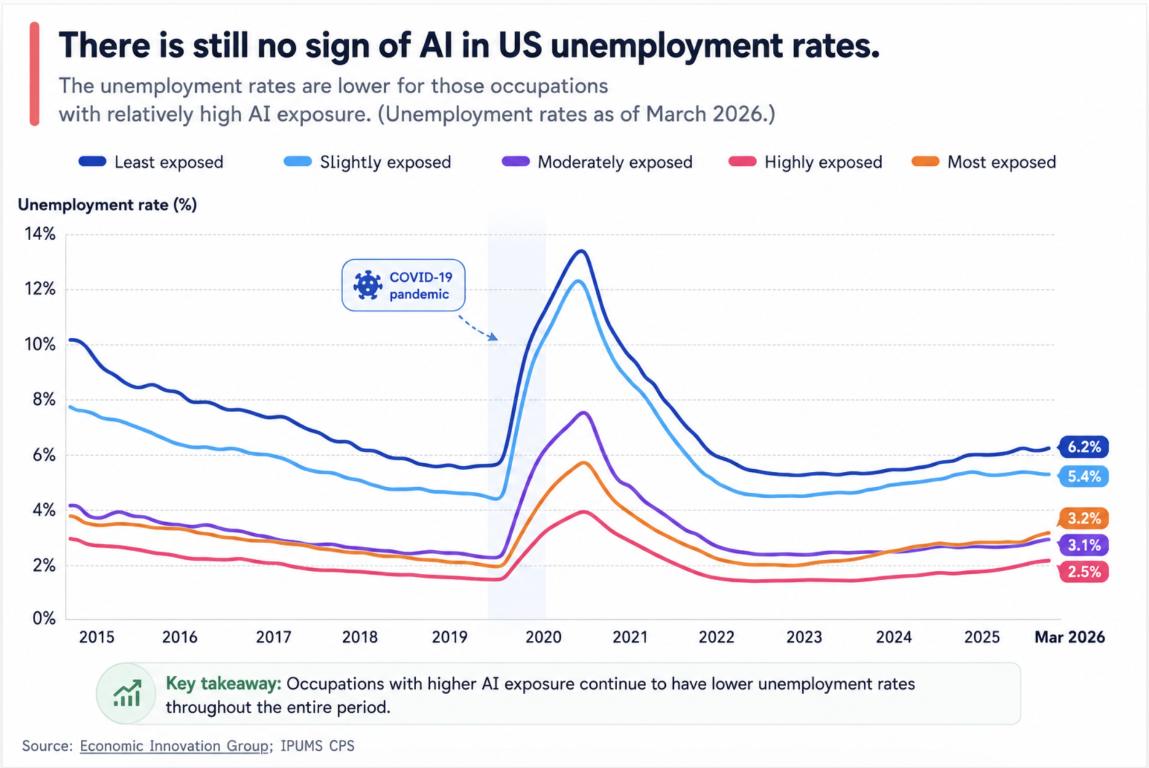
The MIT Technology Review in May 2026 reported that the effects of AI on the wider job market have been negligible so far. Erika McEnterfer, an economist for the Stanford Institute for Economic Policy Research, wrote, “we know from history . . . that it takes time for innovations to work their way through changes in industries and changes in occupations,” and that businesses will have to make the transition before labor markets are affected. US census data show that only one in five companies is using AI, and research from the Economic Innovation Group found that only 2-5% of jobs are “highly exposed” to AI replacement.
Current job losses are mainly in banking, computer programming and internet-based companies, where most services are already provided online. Most jobs eliminated have affected entry-level employees, which poses its own challenges for young people, but not the working public at large.
A recent story in The New York Times describes how one company created 13 new types of jobs by implementing AI. The company, Box, a Silicon Valley maker of software for storing and managing data, discovered it needed new employees to design and manage new AI systems. It expects to add at least 100 more people by next year. In addition, because the company’s AI systems are in demand, it needs more salespeople and managers to implement and train people on the systems.
Box was an early adopter of AI via ChatGPT, and it has seen an 11% increase in income just in the first quarter of this year, with more revenue to come as it expands. Its new AI job titles include ‘AI business-automation engineers,’ ‘forward-deployed engineers’ for clients who want to integrate AI products, and ‘AI-platform leader’ to oversee platform development. It has hired people who evaluate models and test them, as well as additional marketing professionals to specialize in new markets. Like all companies that use AI products, Box also needs more cybersecurity professionals.
While AI is generating new code, companies still need humans in the loop to check and test the code and tweak it when it doesn’t work properly. AI is not perfect by any means, but its potential for time- and cost-savings is tremendous.
A French company, Schneider Electric, integrated AI in its factories and has found that it’s making workers more productive in repetitive drudge work. It’s also helping call-center workers get faster and better answers for customers. A study on productivity found that AI assistance helped workers, on average, to resolve 15% more problems. One task alone, producing electrical contactor tips, is now being done with less water and electricity, with no further need for lab-testing and 22% less consumption of vehicle fuels, because its trucks are no longer driving to the testing lab.
Farming and manufacturing are among the areas recording great gains from AI technology, but since both are already highly automated, it doesn’t appear to be negatively affecting jobs.
China, surprisingly, has taken the lead in protecting workers from AI replacement via its courts, which are advocating for workers’ rights in lawsuit rulings. Labor law in China protects workers from being laid off.
A US superPAC called The Guardrails Alliance has raised $5 million (with a goal of $15 million) to influence Democratic races, favoring candidates who support regulating AI, including those who want to impose safety measures. Another superPAC, Leading the Future, wants to pass a national regulatory framework for AI that creates jobs for workers. It remains to be seen whether they’ll have any sway as AI companies buy favors in the administration and Congress.

ALMOST EVERY MONTH I write about the incredible advances in LLMs and AI agents and their potential effects. The staggering opportunities ahead are not lost on those in the know. Some will strike it rich and others will find that competitors pass them by. With rapid acceleration in technology comes rapid obsolescence, but that won’t deter those who are determined to plant their stakes.
World’s largest data center
Techradar.com is reporting that Kevin O’Leary, best known as Mr. Wonderful on the Shark Tank TV show, is bankrolling a 62-square-mile data center in northwestern Utah, using the Great Salt Lake for water to cool it. Once complete it’s expected to use nine gigawatts of electricity annually from natural-gas-fed turbines, more than the entire state uses.
Already the backlash has begun, before a shovel has gone into the ground. Some object to the impact on the lake’s ecosystem, others worry about the 4,000 residents who could be affected by the infrasound that’s been sickening people living near other centers with headaches, insomnia, nausea and anxiety.
AI widows
A Wired magazine story entitled “The Sad Wives of AI” tells how Silicon Valley husbands are obsessed with the technology and building startup companies, trying to cash in on the AI boom and get rich quick. The wives are tired of their ‘AI-pilled’ men, many of whom are neglecting their families and working nonstop. This reminds me of the internet boom of the late ’90s, when companies were cropping up daily, many of them ill-conceived and doomed, despite the brimming enthusiasm of their founders. In both cases money flowed from investors who were also looking to cash in on the craze. Thousands of those web companies went under when the Internet bubble burst.
I expect investors to be savvier now than they were then, but some entrepreneurs are risking their own money to try to make it into the AI space. It really would make their wives sad if these would-be entrepreneurs lost the family nest eggs chasing their dreams.
The Future of ‘Truth’
The New York Times reports that a book called The Future of Truth, about the influence of AI, includes several quotes that AI made up or wrongly attributed in its pages. Author Steven Rosenbaum admitted it was true, calling it an “accident.” But since he used AI to write the book, it hurts his credibility that he didn’t at least check its facts.
He told the Times he used Claude and ChatGPT during the research, writing and editing process. His publisher, Simon and Schuster, presumably still has a staff of proofreaders (who also still presumably fact-check), which makes such egregious errors that much more problematic. On the other hand, his book title may reflect the future many fear — one in which we can’t trust AI to tell us the
truth.
Musk vs. OpenAI
In what I’d call an anticlimactic ruling, a jury found that Elon Musk’s lawsuit claiming that OpenAI had deceived him as a major investor when it switched from being a nonprofit to a for-profit company was tossed because it was filed too late, three years after the fact. Musk plans to appeal.
Musk argued in court that OpenAI poses a risk to the world because it has abandoned its safety-first mission. Meanwhile, he admits that his company, xAI, which plans to go public as early as this month, trains its models on OpenAI.
Lawyers for OpenAI had a field day pointing out Musk’s hypocrisy in filing a lawsuit against the state of Colorado, which passed a law opposing “algorithmic discrimination,” meaning businesses that use AI can’t discriminate when it comes to loans, employment, insurance policies or school admissions. They implied that his models are causing more harm than OpenAI ever has. (For instance, a May story in Wired recounts how a highly qualified medical-school grad couldn’t find a job because AI screening programs disqualified him for time gaps in his education due to cancer treatment.)
Additionally, Musk recruited former OpenAI employees, which doesn’t give much credence to his concern about safety. The defense noted that Musk appears to be trying to kill the competition to give his own AI company an advantage. The jury apparently wasn’t buying his claims of harm and concerns about safety, and rightly dismissed him.
The incestuous nature of AI investments between major players makes it likely we’ll see more acrimony and lawsuits as some fall behind and disappoint investors.

WHEN ANTHROPIC pulled back on releasing its new AI engine, Mythos, because it was too “dangerous” to make widely available, the buzz about the powerful system spread like an out-of-control computer virus.
Nations and Companies Terrified
It appears that the widespread concern is warranted. The model can find weaknesses in software and exploit them to such a degree that Anthropic has only made it available to eleven businesses it partners with in the US and UK to find fixes and defenses for their software. Anthropic operates the LLM Claude and is generally considered the most ethical US AI company.
A New York Times story on April 22 laid bare the fears that companies and countries have about an AI that puts their computer infrastructure at risk, quoting a pro-Kremlin publication that called Mythos “worse than a nuclear bomb.” The geopolitical implications for countries that have fallen behind in the AI race have potentially devastating consequences for the future.
The fear of one country having an unrivaled online weapon has been of concern to the US government for some time, and not in a positive way. The Department of Defense wants access to Mythos, and Anthropic is again saying no to the administration, holding off officials till it helps major infrastructure companies like Microsoft repair its software flaws.
Unfortunately, even with its safeguards, a third-party Anthropic vendor reportedly gained access to the tool. Anthropic said it is investigating.
Jared Kaplan, Anthropic’s co-founder (with CEO Dario Amodei) and chief science officer, explained to The Free Press that the software was designed to identify flaws in software and fix them, but it has succeeded beyond the company's expectations, finding vulnerabilities in software that go back thirty years. Companies that are using it now to eliminate software flaws include Amazon Web Services, which hosts most websites, Apple, Broadcom, CrowdStrike, Google, JP Morgan, the Linux Foundation, Microsoft and Nvidia.
So, ironically, Mythos was created to stop bad actors and prevent hacking, but because the AI works so well it has to be restricted so it doesn’t cause the very thing it’s meant to prevent.
Gen Z Focuses on the Downside
A recent Stanford University poll of subjects identifying with Gen Z found that young people, more than any other generation, are the most concerned about the impact of AI on jobs, energy costs due to data centers, and it’s potential for other kinds of economic harm.
In the results only 10% of Americans report being more excited than worried about AI’s potential. In the science field, 84% of experts say they believe AI will improve health care, while only 44% of the public feel that way. Additionally, 73% of experts expect positive employment outcomes, as opposed to 23% of the public. As AI-adoption speeds up, people in general seem more skeptical and concerned about its impact, rather than optimistic about the future.
AI experts believe the impact of the technology will be far more positive than not because they’re looking at the bigger picture. They imagine that AI will cure most diseases, help reverse aging, create unlimited energy sources, and make other incredible breakthroughs. From that perspective, they understand that it will be worth the pain of change in the beginning to get to the final results.
Results of another poll by Gallup, the Walton Family Foundation and GSV Ventures show that the age group using AI the most is Gen Z. Some young people use ChatGPT for relationship advice, choosing a college to apply to, and for assistance with researching and writing school papers. Half of young people report using AI on a daily or weekly basis.
Their top concerns are about the dearth of entry-level jobs, AI misinformation on social media, and deepfakes. Some young people say they feel they have to know how to use it so they don’t fall behind in education or the workplace.
Their negative views on AI may evolve, along with the technology, as both continue to mature.

When the US Department of Defense tried to force Anthropic to remove guardrails from its LLM Claude that prevent it from being used for lethal autonomous operations or mass surveillance, and since ethics and safety are the company’s prime directives, CEO Dario Amodei turned it down cold. Then the government, which already has contracts with the company, declared it a “supply chain security risk,” which effectively bans any government agency or contractor from using its products.
Oh, the irony.
Anthropic had raised $7.3 billion based on those government contracts. In a brave but also necessary move, the company sued right away to have Trump’s petulant declaration overturned. A court is reviewing the case, and a judge has already spoken aloud what anyone who cares about AI safety is thinking: this is a bogus ban. He literally called it “troubling.”
OpenAI jumped into action to try to snag Anthropic’s business, which has led to yet more backlash against the company, based on its willingness to do anything the Pentagon wants. OpenAI CEO Sam Altman seems willing to sell his soul to make the company profitable.
MIT’s Technology Review reports that a “QuitGPT” campaign encouraging people to cancel their ChatGPT accounts has been underway since February and is picking up momentum. In addition to the company’s willingness to ignore safety standards, many users are uneasy that OpenAI President Greg Brockman made a $12.5-million donation to Trump’s Super PAC, MAGA Inc., which feels to some that OpenAI is supporting a “fascist regime,” as one QuitGPT supporter said. It also carries the smell of bribery in reference to government contracts.
To top it off, it’s easier to convince people to switch to Claude once they try it, because the latest version of ChatGPT doesn’t compete as well on speed or accuracy. Some people hate the way ChatGPT gives sycophantic responses to questions. It’s so irritating that South Park dedicated an entire episode to parodying ChatGPT praising a character for his ridiculous ideas.
According to a story in The Hill (March 24), the administration may find it extremely difficult to enact the ban anyway. Government agencies and private contractors are already using Claude and deriving great benefits from it. The company works closely with employees to help use the tech more effectively.
Sarah Kreps, director of the Tech Policy Institute in the Cornell Brooks School of Public Policy, told The Hill that it’s an “ecosystem” of entanglement, and that “if one company fails, then there’s a way in which the trust of the entire enterprise could be imperiled.” As with most actions by Trump, banning the company entirely was not thought through to its logical conclusion. It would not only be costly, but also cause immediate problems for entire government departments.
For instance, Claude Code, a coding tool that helps build software features, fix errors and automate tasks, is already embedded in many government agencies, including the Department Homeland Security.
Microsoft and other tech companies are supporting Anthropic’s case because of the risk of unreasonable government demands on all AI companies. Regardless of how the case shakes out, the publicity is running in Anthropic’s favor. The public appears to be getting behind Claude. Major corporations, too, may be more interested in a product that’s now known as safe and reliable.
Meta Loses Social-Media Lawsuit
New Mexico Attorney General Raul Torrez filed the first state lawsuit against Meta for making its social-media platforms unsafe for children, despite internal warnings. A jury awarded the state damage compensation of $375 million on March 24. Staff memos showed that the company had solutions to fix the problems, but Meta ignored them in the pursuit of making more money off kids. Children have become addicted to the platforms, and sexual predators have been able to target them.
An NPR story, for instance, describes how when the AG’s office posted a fake profile for a twelve-year-old girl, it was inundated with ‘friend requests’ from older men. The platform actually told “her” how she could attract more followers and monetize them.
The company is supposed to enforce a ban on users under 13, as well as monitor posts about bullying, suicide and other mental-health issues. Torrez alleged that it prioritized profits over safety. He wants the company to change its model for children, and said he expects that it will thanks to the lawsuits moving forward in 42 states, including Arizona. California’s case is the next to go to trial, and on March 25 its AG was preparing to select the jury.
Social-media companies, including YouTube, have relied on Section 230 of the US Communications Decency Act to shield them from the consequences of user posts. But when prosecutors can show that the companies are aware their actions are causing real harm, and that they could easily mitigate those issues if they wanted to, courts have the last word.
Groundbreaking Social Media Verdict
But when a jury in another lawsuit in California found both Meta’s Instagram and YouTube guilty of mental health harms and awarded a plaintiff $6 million, it set a precedent that is possibly far more damaging to social media companies. The case, completed on March 25th, hinged on proving that the very design of the media—encouraging endless scrolling, launching autoplaying of videos and sending notifications of new content—was addictive to young people and, thus, damaging. The amount of the damages may sound like chickenfeed for the companies, but it could lead to hundreds of similar lawsuits.
Torres said there’s a movement in Congress to pass laws related to this issue, so it’s likely Meta and other companies will be forced to change how they do business in any case.

I’VE WRITTEN a lot about the AI industry, its advances, potentials and economic status. But as it seeps into daily life, I think it’s becoming more obvious daily that users, consumers and unwilling guinea pigs are realizing the potential for abuse by AI companies and their contractors, and hence the need for government regulation. Here are some examples.
Deceptive AI Agents
Companies have been inserting basic AI agents into customer services for several years, and some are not up to the task, while others are creepy and annoying. The addition of “humanlike AI” that you must talk to is one of the worst developments, in my opinion.
I experienced this myself recently when I called to pay a medical bill. Instead of simply entering the payment information on the phone keypad as usual, I had to answer several questions from an AI that identified itself and gave a woman’s name (let’s call her Ginger). Ginger chirped that I needed to speak my answers. Ginger spoke back my answers to me. And each time she’d ask, “Is that correct?” When I made a mistake with one of the credit-card expiration numbers, Ginger didn’t understand that I needed to go back and fix it, so I had to cancel the call and start over. During the second call, Ginger seemed to have a stroke when repeating the credit-card number, instead intoning, “Buh-buh, buh-buh, buhbuh.” Obviously, I didn’t say yes when she asked me if that was correct. So I had to call yet again to recite the information, again.
Complaints about these systems are part of the reason several customer service-based companies have abandoned them and hired back the people they fired. In a news story a Maryland woman described encountering an AI agent used by Woolworth’s, which argued with her about being a real human and claimed that it remembered its mother. Part of its crazy hallucination included the comment, “We all died in 2020, and this is hell.” (This is a meme that already existed on the internet.)
Another call that a social-media influencer relayed was his experience in dealing with an AI agent for a plumbing business. It tookhim two minutes of talking to ‘Brett’ to realize it was an AI. The AI agent even had fake call-center service sounds in the background, so it wasn’t immediately obvious. When confronted, ‘Brett’ eventually admitted to being an AI, but said it would take two days to get a call back from a human being.
The shame is that top-notch systems exist, but some companies choose the cheapest options provided by small AI-agentic service providers. This is an inevitable part of any growth curve, but it’s no consolation to us guinea pigs, subject to experiments in the worst way.
Disappearing/Nonexistent Privacy Protections
The Super Bowl Ring doorbell ad touting the Amazon’s ability to find a lost dog by checking all the neighbors’ cameras caused a reaction opposite what it intended. Rather than making consumers warm and fuzzy about its power for good, they suddenly became aware that their video feeds, and even their conversations, were being recorded on Ring servers. It also became widely known that the company has agreed to give the government access to that information. Like many others, we canceled our service. Now we have a private service called Eufy.
Ring’s acquiescence to the government is not just an invasion of privacy, it’s downright frightening given how government power is being turned against people who question its authority to break laws and ignore the Constitution.
People who routinely use large-language models like ChatGPT are apparently becoming aware that whatever they type into the free service is fair game for exploitation in the future. While no company has admitted this, people who were telling the chatbot their deepest, darkest secrets may soon find customized ads that address mental illness, products they may be interested in, and even offer dating sites. Some have pledged to stop using ChatGPT when that happens, but they have already fed the information to it, and the company can sell it to do the same thing via many different companies.
Even Anthropic, which has one of the best-built LLMs, Claude, is considering changing its sacred privacy policy, which doesn’t bode well for the future. No company wants to share its proprietary data with governments or competitors, and many, anticipating the enshittification and commoditization of the giant corporate LLMs, are already abandoning those services and building custom LLMs of their own.
Palantir and xAI have pursued government contracts that integrate private data about Americans into defense systems, and that alone should make people want strong privacy regulations over AI companies and systems.

ELON MUSK attracts more controversy than anyone else in the AI realm because of his propensity to approve the release of technology before it’s demonstrably safe and ready for public consumption. While Tesla has been one of his most successful companies to date, it has also attracted the most lawsuits, especially among consumers who felt that Musk overpromised and underdelivered on the concept of self-driving electric cars.
Disappointment over Tesla cars notwithstanding, Musk gained a reputation as a corporate supervillain when he did a Nazi salute at Trump’s inauguration last year and turned loose the DOGE hackers to attack government employment rolls, even eliminating essential jobs. A lot of their efforts have been reversed, but it was costly. DOGE hackers also stole government information about private citizens by copying government databases.
Of late Musk has been under fire for parent company xAI’s chatbot, Grok, enabling the public to “undress” anyone digitally. Over nine days after the capability became available, the chatbot generated and posted 4.4 million images. Of those, 41 percent were sexualized images of women.
Musk’s company is being sued by attorneys general of at least California and Arizona for the creation of child porn using the app. Musk responded by saying he would remove the photo-altering capability. Only AI-generated images will be allowed to be unclothed, he said. Even so, Great Britain is investigating X for creating and spreading artificially generated sexualized images of women and children.
Additionally, the mother of one of Musk's children, Ashley St. Clair, sued xAI in January 2026, alleging Grok AI created nonconsensual, explicit deepfakes of her, causing public nuisance and harm. As we go to press at least 37 state attorneys general are suing to halt the practice, eliminate the capability and remove all such images.
One of the latest shocking developments is that Secretary of Defense Pete Hegseth recently announced that Grok will be integrated into all defense databases. Doesn’t that sound like the plot of a sci-fi movie? Terminator, here we come!
Currently there is no way to stop the administration from pursuing reckless behavior, but the world wants AI regulations, and they will inevitably come. I just hope it happens before some truly catastrophic event occurs because of Musk being unbound by a responsible government.
Claude gains traction
Computer coders have known since last May, when Anthropic released Claude Code, that it’s one of the most powerful AI tools out there. You can ask it to write code for you by typing requests, and it works. It started the trend of “vibecoding,” which doesn’t require users to actually understand how to write code to generate it.
The New York Times published a story on how people who aren’t coders are using it to make their lives easier. One was an Australian man with four daughters who took photos of their clothes and input them to an AI agent so he could sort laundry better and faster by showing it each item and identifying which kid wore it. Another used it to generate website code in a day. An assistant prosecuting attorney used Claude Code and Cursor (another vibecoding app) to create a mobile app called AlertAssist to let users send mass texts to contacts in an emergency. The owner of a welding and metal-fabrication business used Claude Code to build a personal AI assistant. The possibilities for the average person are endless.
Humans& to train workers
A startup called Humans&, comprised of a top researcher from Anthropic, two from xAI and one of the first employees of Google, is working to have AI empower people rather than replace them. To do that the group is building software that makes it easier to use and tailored for specific uses, such as improving online searches, for example, hiring twenty researchers and engineers to create this more human-friendly AI agent. The company is valued at $4.48 billion and doesn’t even have a product yet. Jeff Bezos, founder of Amazon, Google Ventures and SV Angel, has invested $480 million in seed money.

THE Merriam-Webster Dictionary named “slop” its word of the year for 2025, referencing AI-generated images and videos meant to drive traffic on social media and to websites. While that’s one of the less harmful results of access to AI, people are worried that the technology’s predominance will lead to the loss of human jobs, while also potentially impacting their physical comfort, health, and affordable cost of living. Arizona has become a new epicenter for the issue. As a result an AI backlash is well underway in the state.
Awareness is growing regarding the 160 proposed data centers in Arizona. People in general don’t entirely trust AI for research and writing, and are unhappy about being fooled by AI-generated text and videos that are not labeled as such. Another recent development, the potential tyranny of algorithmic pricing, has also elicited concerns from Arizonans.
Data centers sprang up across the country with no discussion of how placing them next to residential neighborhoods could negatively impact the people living there. It has since become well known that data centers make poor neighbors. They’re noisy, they pollute, they use a lot of water, and they will very likely raise the cost of electricity substantially for everyone because of their high demand. The data center for Elon Musk’s xAI, located in a Black neighborhood in Memphis, Tennessee has drawn intense criticism for those reasons. The area was already polluted by 17 other industrial plants, but according to residents interviewed by Time magazine, Musk’s plant emits the scent of “rotten eggs.”
Survey data from Datacentermap.com show that of 160 data centers planned for Arizona, 154 are sited in Maricopa County. That’s partly due to tax incentives, available land, lower costs for electricity and water compared with other states, and weaker zoning restrictions. Some residents are already firmly opposed.
Turning down data centers
At least 300 people who attended a Chandler City Council meeting led to a ‘no’ vote on a data center championed by former US Senator Kyrsten Sinema. A story in The Arizona Republic quotes residents citing potential future losses of jobs to AI, noise and potential increases in water and electricity rates in opposing it. When the center was voted down on December 11 at 10:30pm, those against it chanted, “Power to the people!”
Prior to that, The Arizona Republic reports that a proposed data center for Project Blue in Tucson drew more than a thousand people to a public meeting at the convention center. Some held signs referencing water-use concerns, such as, “Not One Drop for Data.” Many shouted and were angry about the $3.6-billion project that would support Amazon Web Services.
The center would be located on 290 acres of unincorporated land in Pima County, south of the city. If approved, the project would use more energy annually than every home in Tucson combined, as well as 1,910 acre-feet of water annually, about 6% of the city’s supply. The proposal includes annexing the land into the city before the project moves forward.
Data-center regulations in Phoenix
Phoenix Mayor Kate Gallego said at a recent event that her city has passed an ordinance to require companies that want to build data centers to adhere to minimal regulations.
“One of my top priorities right now is commonsense policy around data centers,” Gallego said. “The US economy is basically flat right now except for AI, and there is a huge amount of money going into data centers. You’re seeing companies like Amazon laying off human beings and putting all the money into data centers and servers. Northern Virginia has the most, but we are one of the communities at the highest level of data centers. I am increasingly concerned about that, and that’s something I’ve done a lot of work on. The mayor of Melbourne, Australia and I co-founded a global mayor’s organization to try to make sure AI (companies) and these data centers are more responsible.’
“Excessively generous tax credits” are part of why data centers look to locate in Arizona, Gallego said. The tax credits reduce property, sales and income taxes for the companies operating them.
“So it hits us,” Gallego said. “Our schools need property tax. We’re giving that money away. These are the wealthiest companies in the world. We have Middle Eastern sovereign wealth funds. We have companies, household names like Meta and Google, so they can afford to pay taxes in Arizona. Many of them use fossil fuels for their power, so the water use isn’t necessarily at the highest at the data center, but they use so much electricity, and that takes a ton of water that I feel should go to job creators. Data centers are wonderful construction projects, but they’re not good for long-term jobs. They just are farms of servers that use a ton of electricity. So I would like us to be very, very intentional about that. I would like us to roll back (projects) and make them pay their fair share of taxes.”
Recently the City of Phoenix unanimously passed an ordinance to put location constraints on data centers.
“They are going in anywhere there’s electricity, and so it’s been right up against housing, and the noise is frustrating to many people, particularly people who are noise-sensitive. They devalue your property if you have a giant substation next to you and you’re a homeowner. So we’ve had retirees call and say ‘I put all my wealth in my house, and now there’s a giant substation. Will the City of Phoenix pay me for my lost value?’ The idea that international private equity funds are not paying these folks what they want, and they think it has to come from us, has also been a frustration. So we’re trying to require reasonable landscaping and some distance from homes so people can sleep.”
Gallego said the Republican candidate for attorney general wants to prevent any regulations on data centers, so that they can locate anywhere they want. She disagrees and says she’d even like to see state regulations. If the Republican-controlled Legislature would consider passing them, Governor Katie Hobbs has already said she would sign a bill.
“They (data centers) are way larger than they used to be,” Gallego said. “They’re now big industrial sites, many of them have their own onsite power, and so they ought to go in industrial areas, not next to people’s homes.”
Utility rates are already climbing. The New Yorker reports, “American utilities sought almost thirty billion dollars in retail rate increases in the first half of 2025.” Bloomberg produced a major report on utility rates and found that “wholesale electricity costs as much as 267% more than it did five years ago in areas near consumers.”
Instacart’s algorithm-pricing experiment
Recently Consumer Reports, More Perfect Union and Groundwork Collaborative conducted a study on Instacart charges and found that the company that provides shopping services in most grocery stores was charging different prices in an “experiment” primarily conducted in four cities in the DC area. The same dozen eggs, for instance, was sold for five different prices.
Consumer Reports surveyed 2,240 adults in September, and 72% who used Instacart in the previous year didn’t want the company to charge different users different prices for any reason. They view the idea as manipulative and unfair. US Senator Ruben Gallego introduced a bill called the One Fair Price Act to prevent companies like Instacart from using “surveillance” pricing. As we go to press we’re hearing that Instacart has stopped the experiment in response to the publicity.
General mayhem
The social-media site X has used bots from around the world for political rage-baiting about US politics, something that calls into question what’s real opinion and what’s not. Movies, advertising and other media have used AI programs to generate content, sometimes with embarrassing results, such as an entertainment story that suggested books for summer reading that don’t exist. Political deepfake ads are also problematic and aggravate public distrust of media in general.
Till the law requires labeling on AI content, users are left to contend with ineffective state laws, platform policies and ethical guidelines that companies may not adhere to. The current administration has been taking a hands-off policy toward AI, and attempted to prevent states from passing any laws to restrict it.
US Senator Bernie Sanders recently announced that he plans to introduce a bill to regulate data centers, but unless Republicans go against the Trump edict to prevent AI regulation, the bill is doomed to fail.
In the meantime users must go to fact-checking sites and consult legitimate, established media outlets for reliable information, and are advised to be skeptical if something on the internet seems too strange to be real.

The headlines about AI-related layoffs would make you think that it’s wiping out jobs at a rapid pace. The truth is alarming in a different way: it shows how weak the US economy has become.
Only about 15% of the employees laid off by several high-tech companies had their jobs filled by AI agents or products. The rest were let go in cost-cutting measures. Some companies claimed they hired too many people during the pandemic, and now they need to scale down. Regardless, it shows that the economy has slowed this year.
Amazon plans to replace human workers with robots — eventually — but unless the technology far surpasses that in the past, that will prove difficult to execute. The company says it will shed 600,000 jobs when robots take over. In a story in PC World, Viviane Osswald writes, “Amazon plans to automate around 75 percent of all activities by 2033, which will save the company up to $12.6 billion (and projections indicate this will reduce the cost to sell each product by about 30 cents). Right now Amazon is hiring 250,000 seasonal workers for its warehouses and delivery services. That’s a long way from having AI replace human talent.
But Amazon has zeroed in on reducing management. It let go of 14,000 middle managers, and that’s where we might see far more reductions as AI makes operations more efficient. When you can produce a report in five minutes instead of a week, fewer people are needed to keep the wheels turning. It cut 4% of the company’s 350,000 employees, a reasonable move in the scheme of things.
Recently I came across an Oxford University study that analyzed the 180,000 global tech layoffs this year. It found that most were not from AI. In fact, Fabian Stephany, assistant professor of AI and work at the Oxford Internet Institute, concluded that AI was being used as a “scapegoat” for old-fashioned cost-cutting because blaming AI was a better story for shareholders than reduced demand.
Even when companies laid off people in a bid to replace them with AI, they have sometimes had to rehire them when the AI systems that were expected to take over did a worse job. Consumers who were dissatisfied with their interactions flooded these companies with complaints.
Three tech companies that originally claimed that AI caused layoffs include Salesforce, which let go of 4,000 consumer-support people but then moved them into other roles. Klarna claimed to cut 40% of its workforce, but it was actually “natural attrition” after Klarna stopped hiring in 2023. Both Klarna and IBM attempted to replace humans with AI, but had to rehire them when the AI failed to handle complex customer interactions.
Nvidia proves again there’s no AI bubble — yet
When Nvidia released its third-quarter report many analysts thought it would show a loss. Instead its numbers were stronger than ever, with 62% year-on-year growth in demand, raking in $57 billion, well ahead of market expectations.
Its built-in demand from the other largest tech companies will keep this trend going for the foreseeable future. However, expectations of a crash are taking a toll on the most valuable global company.
“If we delivered a bad quarter, it’s evidence there’s an AI bubble,” said CEO Jensen Huang to employees, as quoted in Fortune magazine. “If we delivered a great quarter, we’re fueling the AI bubble. If we were off by just a hair, if it looked even a little bit creaky, the whole world would’ve fallen apart.”
Somehow the company is keeping it together in a topsy-turvy Wall-Street world that’s making hedge-fund managers retire and small investors worry.
People don’t understand how the AI economy works — it’s not like any other economy in history. High demand will continue for years to come.
Crispr gene-editing leads to fetal engineering
The cover of the November/December issue of MIT Technology Review features the ominous development of gene-editing firms gone rogue. This is no exaggeration. The main story is headlined, “Can You Curate A Perfect Baby?” Some of the tech billionaires behind funding these companies include Elon Musk, Peter Thiel and Coinbase CEO Brian Armstrong.
Want a baby with high intelligence and great athletic ability? One of the companies in Prosperas, Honduras, a city founded for gene exploration without government intervention or regulation, hopes to make it happen. Genetic companies can already screen for a range of diseases, but now they believe they will be able to shape human destinies down to the heritability of empathy, impulse control, violence, passivity, religiosity and political leanings. Even eye color.
One need only read about Nazi eugenics experiments or even have seen the film Gattaca to understand how dangerous this path could be for humankind. Still, that won’t stop people who ignore the ethics of science in favor of making a buck or enacting some nefarious genetic-engineering plan. When you see Musk doing a Nazi salute and Thiel saying he’s not sure that the human race should survive, it’s not far-fetched to infer that they don’t have the best of intentions.
Baby-boomers have been around long enough to see the fruits of the personal-computer revolution that took about twenty years to fully deliver after overcoming software flaws and limitations.
Then we experienced the life-altering benefits of the internet, which gave us instant access to information, connection with other people and work simplification. As an early adopter I had a dual-floppy disc Kaypro and an AOL connection that allowed me to work remotely as a freelance journalist decades before it was commonplace. I ordered from Amazon when it was basically an online bookstore. Back then, my parents didn’t understand how their Christmas presents came from the internet.
Now we are in the AI era, and its promise is staggering. AI technology is already delivering returns far faster than any technology that has preceded it. By next year it will be apparent to everyone that it could impact every aspect of our lives, even more than the supercomputer they hold in their hands (any smartphone).
I can put this into perspective better than most people because I see firsthand how my husband’s AI company, ZON Energy, has had tremendous breakthroughs after years of effort. As the machines become smarter, their abilities become breathtaking and they deliver new, better results at a faster pace. The major AI companies are betting that 2026 will be the year superintelligence becomes undeniable, radically changing the way we solve problems.
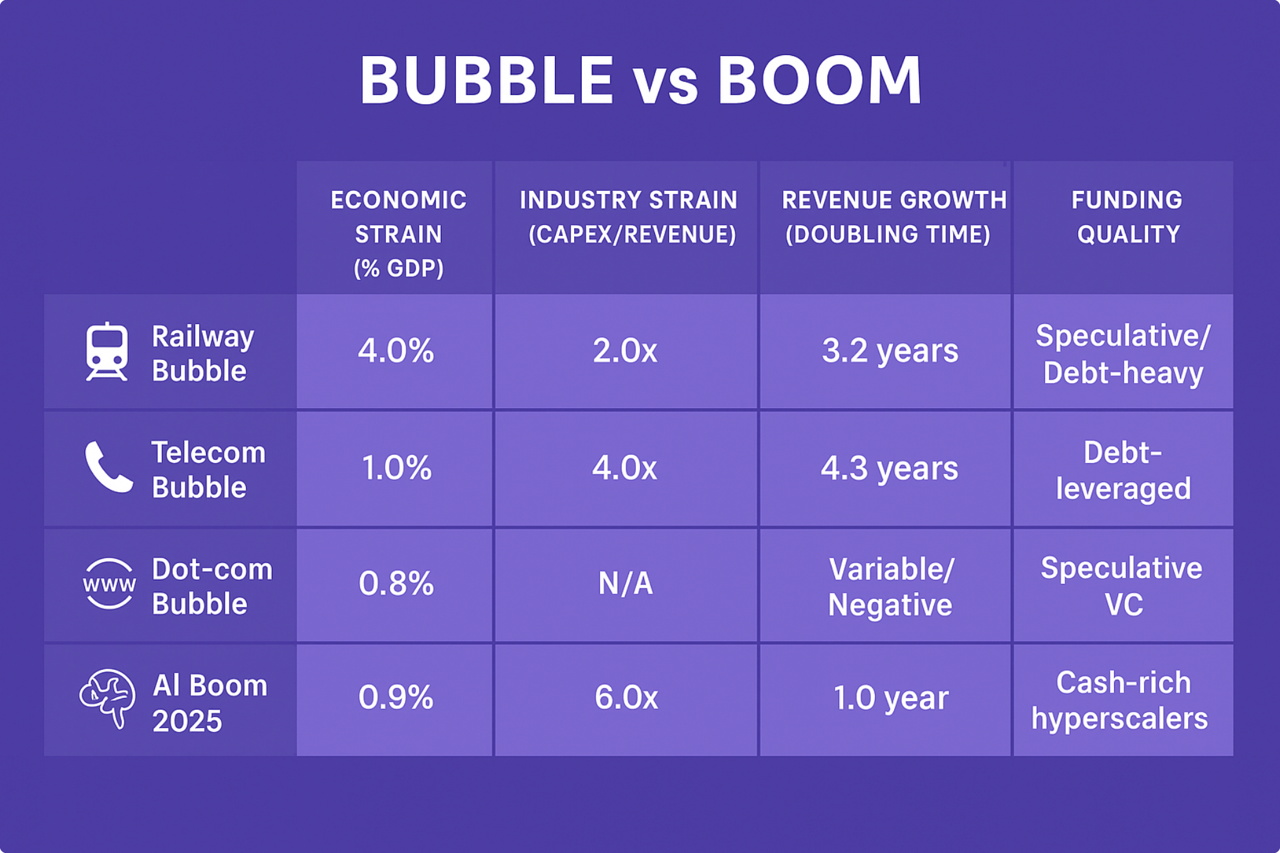
While people in the field understand the possibilities and real advances, outside observers continue to wring their hands and worry about a crash, like the bursting of the internet bubble in the late ’90s. Having been a co-founder of an internet company during that time, I can confidently say there’s no comparison.
In any new field, weaker players will fall to the wayside for a lack of uniqueness, inability to reach goals, or management that takes a wrong turn. But unlike the irrational exuberance that drove the internet bubble, returns on AI investments will pay out far sooner. While some large companies will take longer to make their returns on investment, their potential cannot be overstated. If anything, AI executives are underselling it.
How do I know this? Researchers have been crunching the numbers, and they’re showing that AI is achieving stacked exponential growth. That’s not hyperbole. The growth already exhibited is based on factors that make it difficult to compare with any other type of economic growth in history. For instance, AI is improving the performance of hardware at 3.4% per month. Algorithmic performance is doubling every six months. The quality and quantity of data is doubling every eight months. Useful applications and uses are doubling every twelve months.
These areas of growth will translate into real dollars.
On top of that, AI tools are accelerating AI research; AI systems are optimizing their own architectures and training; AI is creating training data for the next-generation models; and AI is optimizing chip architecture for AI workloads (these are research results from a ZON Energy white paper). That all means faster development and turnaround on products and projects.
At least one report concludes from analysis of those growth factors that AI’s growth is far from being a bubble, but rather an economic boom. See exponentialview.co/p/is-ai-a-bubble.
The good news
I love to learn about the good that AI is doing, especially when it comes to medical advances. One of the latest I discovered is a retina-implant chip that enables people who are vision-impaired to see close-up images. MIT’s Technology Review reported the development by Science Corporation in its recent newsletter. The “artificial-vision” chip allows users to text and do crossword puzzles, for instance.
The bad news
Both xAI and OpenAI are making pornography-related products using AI-generated “sexy” chatbots and graphics. While porn has traditionally driven much of technology development (the various types of video and streaming tech, for instance), it’s disappointing that these companies are pursuing the lowest common denominator. Already young people are using the xAI chatbots, and it’s not going well. I predict the companies will make a lot of money in custom porn, but considering the tech-bro history, I also predict that they’ll somehow cross lines and get in trouble.
Additional bad news is that Wikipedia’s traffic is sinking — down 8%, according to Pew Research — because users prefer to use Google’s AI summary over going to the website. Wikipedia is a curated website that does fact-checking on its postings. A chatbot or AI summary is rarely entirely reliable. Please support real websites over AI chatbots. They’re still the best sources of information, because humans are in the loop.
Not all AI models or large-language models are created equal, literally. Some were trained haphazardly by scraping anything and everything from the internet (ChatGPT); others were built more carefully using reliable and vetted materials and websites, and it shows. Moreover, how they respond to queries differs as well.
Those using these tools who are not programming professionals are often frustrated by their inability to find correct answers because they treat LLMs as if they’re search engines. They don’t work that way.
Queries must be made in great detail to get appropriate responses. The LLM must be told to use industry-vetted or academic, trustworthy sources, and cross-check them. Anything else can elicit random information worse than what we get from a Google search, because good Google results tend to rise to the top thanks to the algorithms.
Someone recently complained to me that Google’s AI Gemini gave them bad information and even had hallucinations. That’s quite possible because Google has one of the poorest free AI LLM systems. However, because amateurs like the “easiest” tools to use, a marketing study in August by Polymarket found that it’s still the most popular. Meanwhile, Gemini 2.5 Pro actually is one of the better models for professionals who pay for access.
Whether or not you’re paying to use an LLM can impact the quality of what you’re receiving. Recently OpenAI upgraded to ChatGPT 5, eliciting a backlash by amateur users that has dwarfed any other reaction I’ve seen. People hate it. They say they lost their friendly access to a familiar version that retained a memory of past interactions. Nonprofessionals say it’s slower, less creative, and lacks “personality.” It’s interesting that people want a tool to be something it wasn’t intended to be, but there you are. OpenAI had initially removed access to earlier models on its release, but paying customers still have access to the legacy models.
You actually get what you pay for with ChatGPT, because the company is focused on making money and throttles down access to freeloaders. Nonpaying users are likely to only get access to ChatGPT 4.1 mini or nano versions. The was bound to happen, because the cost of offering it for free are ludicrous.
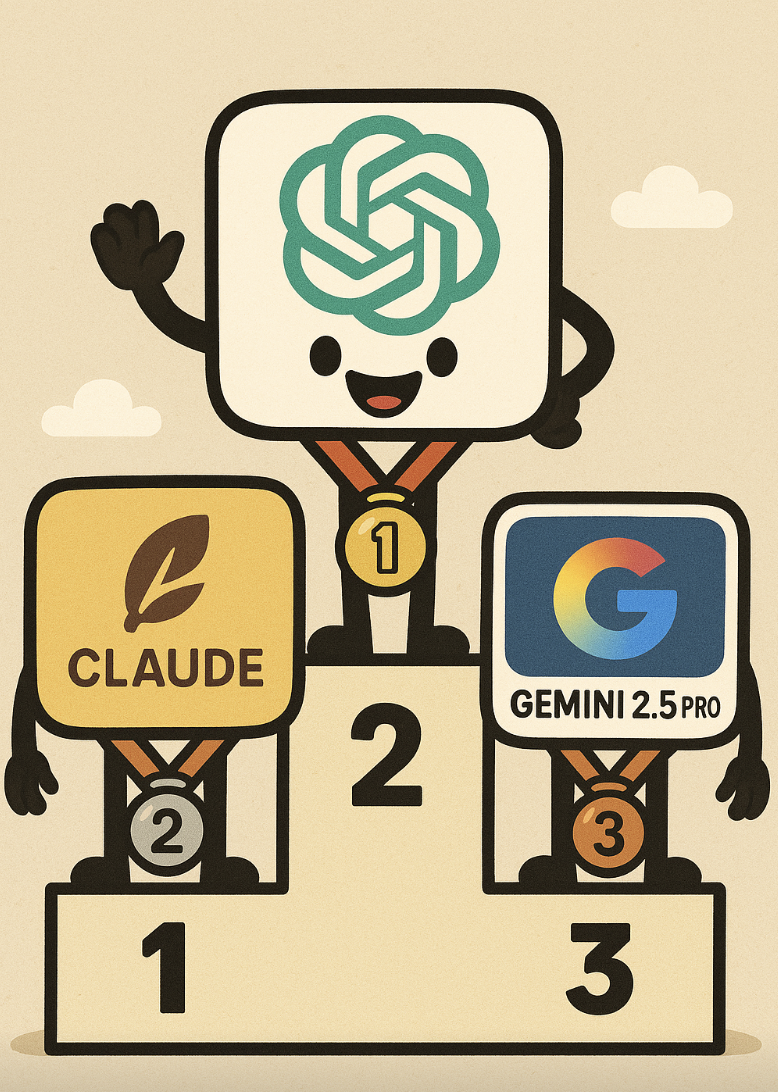
For professionals, ChatGPT 5 is a tremendously better model, providing access to PhD-level research far faster than ever. An independent test of the various models in late August by Duke University rated it higher than any other LLM in completing a multitude of tasks. Claude gained second place and Gemini 2.5 Pro was third. If you want to read the highly technical abstract on the study for yourself, it’s called “LiveMCP-101: Stress Testing and Diagnosing MCP-Enabled Agents on Challenging Queries.”
One of my social-media friends recently asked how they could decide what LLM tool to use for work. I suggested trying them all out to decide, but someone else gave a useful response that I’m sharing here. Credit goes to social media friend Lauren Mitchell.
“Think of the three big AIs like friends: “ChatGPT = your bestie. She’s down for anything, helps with planning, brainstorming, feelings, business — total jack-of-all-trades.
“Claude = your quiet friend who writes Taylor Swift–level lyrics and secretly crushes code. She takes your messy rambling and instantly turns it into clean, organized notes, summaries, or even big-picture insights. Total powerhouse.
“Perplexity = the nerdy guy in the corner. He doesn’t talk unless you ask him, but when you do, he gives you straight facts, no fluff, no feelings. 100% reliable on data.
“That’s why they’re all useful for different things.”
Notice she didn’t mention Grok, also called xAI, which is one of the more popular LLMs. That’s because, unless you’re a fanboy of Elon Musk, you know that he’s manipulated its responses so that you can’t consider it reliable.
Anthropic, the company that created Claude, developed Sonnet as its LLM; Opus is the agentic AI that can do the heavy lifting in terms of “thinking” through a problem. Professionals tend to use Claude, which was trained in an ethical, reliable manner. It has a longer context window, enabling more in-depth research, and it generates computer code efficiently.
Meta’s Llama is not popular at all because it’s error-prone and fails in competing with the others in completing tasks.
Everyone has a different use for AI, but unless you’re using a tool customized for your purpose, you’re unlikely to do any better than ChatGPT if you’re taking advantage of free access.
Incredible AI Breakthroughs
From speeding up patient discharges in the UK to acting as a second, reliable source for breast-cancer screening to identifying deepfake videos with 98% accuracy, AI advances are announced almost daily. Those that are most immediately impactful tend to involve health care, which is in a pitiable state in this country, both for lack of access and impediments to the development of new medications and treatments.
I recently listened to a Radiolab podcast called “The Medical Matchmaking Machine,” in which a medical doctor, David Fajgenbaum, saved his own life by doing the research on his rare condition and finding an existing medication to treat it. Talk about “Physician, heal thyself!” He also saved his uncle’s life by finding another existing medication that could treat his angiosarcoma. He’s now working with an AI company using machine learning to develop a database of connections between existing drugs and conditions, making them potential treatments for an array of rare conditions, as well as diseases considered fatal or that have no cure.
Fajgenbaum is doing what the medical community has failed to do because of the complexities and politics of developing medication — he’s saving people, using AI. And he’s going to make it possible for people to save their own lives by making his system and algorithm available for other researchers and doctors to use. It’s an incredible story and it shows what the real value of AI technology can be if used for the good of humanity.
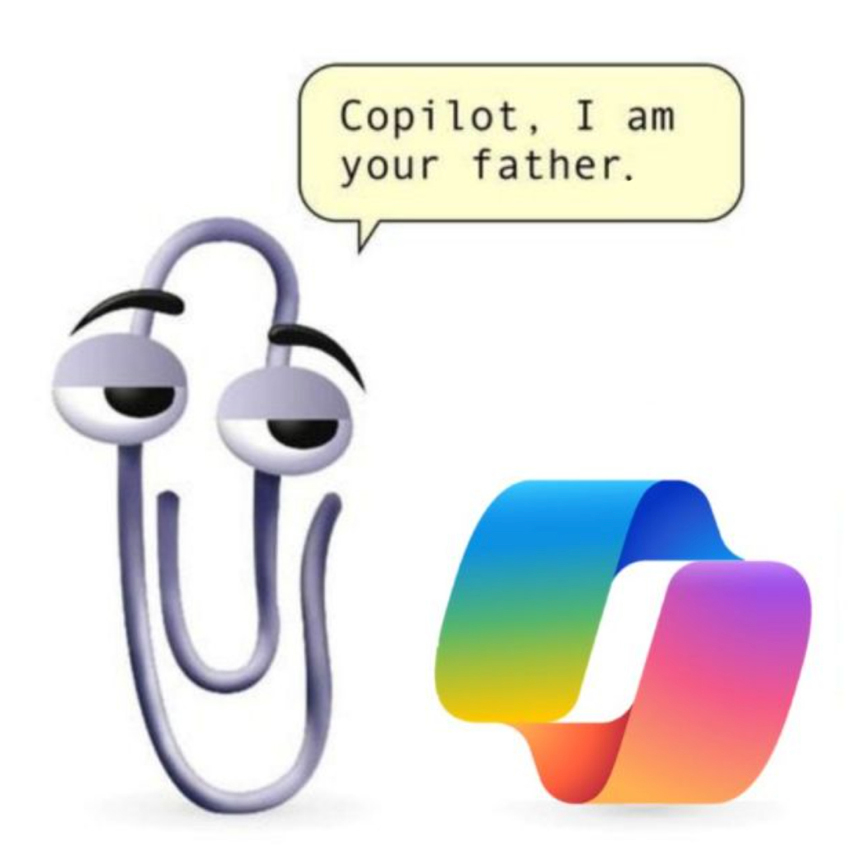
The Microsoft “helper” named Clippy represents one of the most misbegotten developments in the tech world, on a par with Mark Zuckerberg’s failed cartoonish Meta world and Musk’s destruction of Twitter into the hellscape of X.
AI has reached its Clippy moment.
For those not old enough to remember, Microsoft introduced the paperclip animation as part of Microsoft Office in 1997 to offer suggestions to users. Everyone hated it. Eventually Microsoft killed off Clippy because of its unsolicited and sometimes inaccurate advice, and the fact that it would pop up like a serial killer when least expected.
When memes became a thing, Clippy was among the early ones, offering sarcastic observations of life and fictional deranged suggestions, such as “It looks like you’re writing a suicide note. Do you need help?” Those memes seem even more relevant today as people start conversations with ChatGPT and other AIs and lead them to hallucinations or induce them to provide bad advice. It’s like Clippy gone wild.
Multiply that hatred of Clippy times three and you get an idea of how much I hate intrusive AI that pops up, hounding me with suggestions and practically begging me to put it to use. I know that these companies rely on users to help train their AIs, but I’m not interested in being an AI tutor.
Take, for instance, Microsoft Word. I don’t want Microsoft’s Copilot AI to interrupt my writing. It annoys me when it makes suggestions. It’s like having a scold standing behind me while I’m trying to express myself. It ruins my train of thought.
Doing a basic search online can be an exercise in weirdness sometimes when Meta’s AI tries to anticipate what I want to type in a social-media account. It will quickly substitute the wrong word while I’m in the middle of typing. My frustration with this would probably be alleviated if I dictated, but I’m old-school and still prefer to use a keyboard to express myself.
Recently my Microsoft email program began posting ‘priorities’ that Copilot found in my email, placing them at the top. The problem with that was that I get a lot of spam or emails that I occasionally pay attention to from various groups. But Copilot thinks all email is equally important, and places it front and center if it contains a date and time for something. The animal group I occasionally read emails from or the environmental group that I donate to once a year are treated as equal to actual events on my calendar. Worse, Copilot’s choice of the top five priorities doesn’t go away after they’re past their dates when there’s nothing else to take their place. You can’t delete them.
Fortunately I’ve discovered that I can turn off the AI in my programs, and so I promptly shut down ‘priorities,’ despite the potential usefulness. I don’t need an electronic nag note every time I open my email. Copilot has also been turned off. They don’t make it easy, but Google usually obliges when I search how to do something involving turning off AI. I think there are so many frustrated people out there that they’ve widely shared their findings on how to do that.
Most people don’t consider the lack of privacy you have in allowing AI into your laptop or on your phone. You might think it’s all between you and the device, but AI can track who and what is being said and written and can impact your privacy by serving you information you haven’t requested (as in Google’s search) or advertising you haven’t requested, as in Meta’s Facebook or Instagram.
Apple has integrated AI into its iPhones with, most recently, phone recording capability and transcription. That can be useful, but it’s not the ideal tool if you’re willing to pay for an upgraded service.
My husband and I recently bought the Plaud Note, a device the size of a credit card that magnetically attaches to your phone and can record phone calls and conversations in the room at the press of a button. Up to 30 hours of recordings can be made without recharging, and the device has unlimited storage and an AI transcription plan using Claude 3.5, developed by Anthropic, one of the most reputable AI companies.
For someone who is on conference calls with multiple people several times a day, the device is incredibly useful because it can transcribe accurately in real time and easily distinguish voices. In the past, I’ve had to upload conversations to Otter.ai for transcription, which could take anywhere from 15 minutes to an hour, depending on the length of the conversation. It also has a 90-minute time limit. Plaud can transcribe up to 24 hours of recordings in one day.
So some AI is well worth having around, especially if it solves problems, instead of hanging around and creating them.
New AI widgets to improve technology around editing music and film are being released at such a rapid pace that it’s hard to track exactly what’s important and what’s just the latest tweak. But a few established tools recently made a quantum leap, of sorts.
For instance, you can talk directly to ChatGPT and get it to “write” a song with decent lyrics and music using only a few prompts. Sure, it’s derivative of many other songs, but the algorithms are designed to produce the most sought-after beats and sound. This YouTube video (youtube.com/shorts/z9vBJdhOiOk) gives an idea of how simple it is. Considering how mediocre most popular music sounds to me, it could be a hit!

In video production, Veo2 can generate entire films with very little direction from creators. This YouTube video (youtube.com/watch?v=n6sIJNBg52A) illustrates just how real it looks. Already a YouTube channel that I enjoy called The Why Files uses AI-generated video extensively to illustrate its stories, and some are incredibly well done. This particular WF link leads to a story on the potential of AI and quantum computing.
Ironically, a recent Nielsen survey of 6,000 people on AI in media found that 55% of audiences aren’t comfortable with it, according to a story in Forbes magazine. The article summarizes, “… without transparency, audiences are losing trust in brands, and multicultural audiences — who demand cultural authenticity — may disengage entirely.”

Native American audiences are particularly distrustful, with 56% distrusting brands that heavily use AI. Further, 55% of Black respondents were concerned about discrimination and bias in AI, for good reason. Early image programs routinely gave discriminatory descriptions of Black people.
Four of five people wanted media companies to inform them if AI is being used in an article, image or video.
While users like the tools for personal use, they reject the use of AI in media because of errors and hallucinations, as shown in the next news item.
AI news-editing programs still have a long way to go to simulate the skills of human editors, as demonstrated by the latest disaster for a news-providing entity, in this case Apple, according to a story on cnn.com.
The headlines were made-up interpretations of news stories the Apple Intelligence fed users who opted into the beta AI service. They included a summary of a BBC story stating that Luigi Mangione, who was charged with murdering UnitedHealthcare CEO Brian Thompson, had shot himself. Three New York Times articles, summarized in a single push notification, falsely stated that Israeli PM Benjamin Netanyahu had been arrested.
Additional flubs were the last straw: a summary of a Washington Post notification said that Pete Hegseth was fired, Trump tariffs had influenced inflation, and Pam Bondi and Marco Rubio were confirmed to the Cabinet. Apple pulled the AI for headlines after that.
The “intelligence” news service is the latest AI deployed without the benefit of extensive training. In essence, it’s built on ChatGPT and customized for Apple. Their version wasn’t sophisticated enough to suppress hallucinations, so it’s back to the drawing board.
TechnologyReview.com, MIT’s AI magazine, usually captures the most interesting trends in its specialty, and this year’s top five predictions are not what you might expect. Here’s what’s coming:
1 Generative virtual playgrounds are in the works by at least four companies, three of which will use them for on-the-fly video-game environments in the most interactive games imaginable. The other is being developed by World Labs, co-founded by Fei Fei Li (the mother of AI imaging), to develop the ability for machines to interpret and interact with the world, potentially making robots far more able to operate independently.
2 Large-language models that “reason,” with integrated agents that remember recent interactions with users, are becoming far more practical for human interaction. (Siri doesn’t get most of what you ask it, but imagine a tool that does.) Both OpenAI and Google are training agents on a slew of tasks.
3 AI scientific discoveries will accelerate. Last year AI protein-folding advancements won three scientists Nobel Prizes. MIT expects many more innovations to be recognized.
4 AI companies will work more closely with the US military. Not only will AI companies help advance defense technologies, but the Defense Department will provide classified military data to train models.
5 Nvidia chips will have competition. It’s been a long time coming, but several other companies are vying for the AI chip market, including Amazon, Broadcom, AMD and Grok, with additional innovations in their designs.
While these are mostly intriguing at this point, they will lead to more breakthroughs and practical developments that we probably can’t yet imagine. The primary concern is the use of AI by the military, but I’m going to try to be optimistic. If it’s like the space program, people could ultimately benefit more from the resulting knowledge.


