


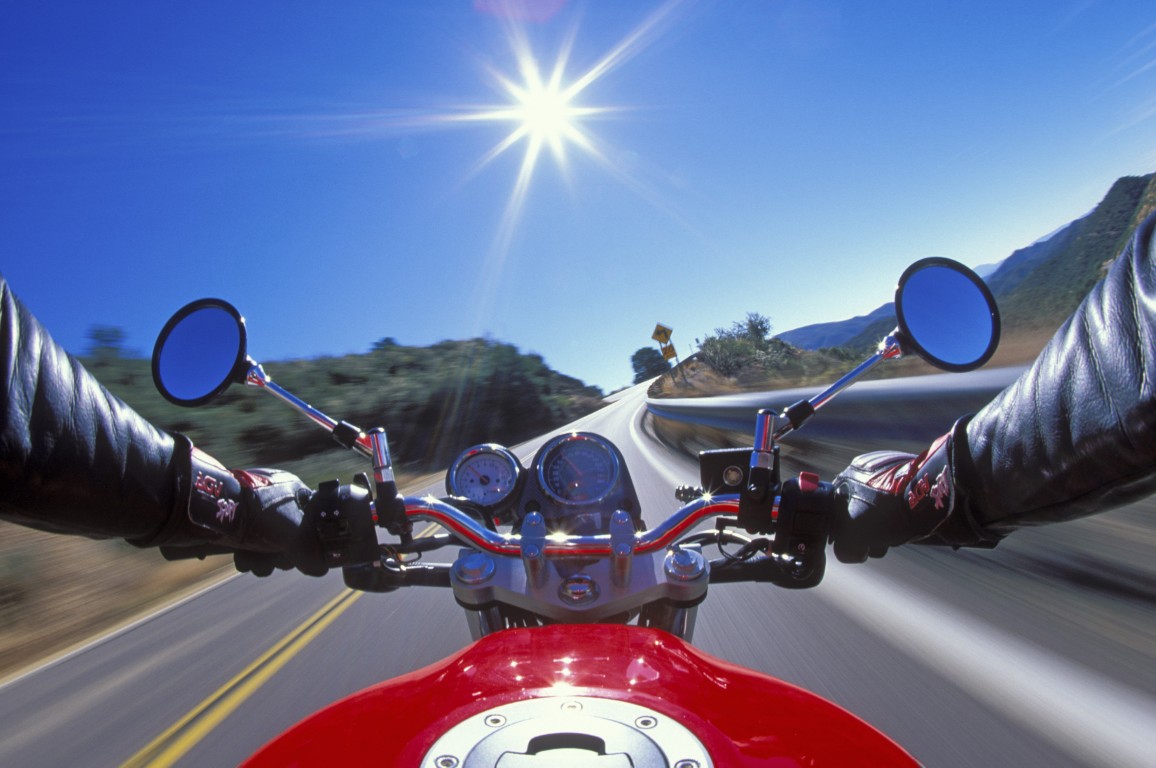
SINCE CHILDHOOD I’ve been a motorcyclist. As a kid in the ‘60s and ‘70s I saw that you really did “meet the nicest people on a Honda.” And more nice people on Yamahas, Suzukis, Kawasakis and all the other marques.
I begged my parents for a minibike, and one Christmas I found a Honda Mini-Trail under the tree. It was a little thing, with a 50cc four-stroke motor that may have made five horsepower. Surprisingly it was street-legal, but I was too young to get my license, and with a top speed of maybe thirty miles per hour you really didn’t want to mix it up with traffic on such a little machine. Offroad I rode the wheels off the thing, developed my abilities and honed my skills.
I got my motorcycle license at 15, and as I grew I graduated to larger, faster and more powerful bikes. The next ones were simple, smoky, ring-ding, air-cooled two-strokes. A 90cc Suzuki, then a full-sized Yamaha 175, finally an exotic Spanish 250cc Ossa.
In the ‘70s I could ride my bike to school, and on the weekends remove the lights, mount number plates and go motocross racing, where I became a notorious crasher. Yes, I’ve collected a number of broken bones over the years, but we went by the old Evel Knievel adage: “Pain is temporary, bones heal and chicks dig scars.” Like most kids of my age I felt immortal, and always got back on the bike after recovering from various injuries.
I sold my motorcycle to partially fund my college tuition, and for the next decade didn’t own a bike and had no thought about getting one, till one fateful day.
After college I was living in Texas, and one day visited a friend at his shop. He’d just finished the restoration of a 1979 Husqvarna 250cc motocrosser. This was the motorcycle my dad would never let me get as a kid, telling me, “You’ll kill yourself on that thing.” My friend handed the bike off to me and said, “Take a few laps around the parking lot.” Two laps and a couple of wheelies later the motorcycle bug bit again. As I handed the bike back to him, I said, “I’ve got to get a bike and go riding with you.”
I did! I found another 1979 Husky motocrosser, restored it, went riding with my friend and promptly crashed into a tree, breaking my wrist. Not an auspicious reentry to the sport.
I finally understood why dad wouldn’t let me get one as a kid. It was an evil-handling beast with a throttle that was basically a light switch, either bogging down and barely running or hauling ass. Wheelies and wheelspin. Once that back tire hooked up and got traction you’d better be pointing where you want to go, because it was a rocket-with-a-sprocket! That happened to me, and that damn tree got in the way. Still sporting a cast on my wrist, I traded it for a much easier-to-ride Kawasaki.
For the next few years I rode with a group of guys. We’d truck our bikes up to the designated off-road riding area in the national forest north of Houston, ride all day, and come home tired and dirty, with big grins on our faces. Over time our band of riders got smaller and smaller as girlfriends, wives and babies forced the guys to leave riding one by one. Finally it was just me and one other guy, because I had a girlfriend who was cool with it and he didn’t have one at all. Both of us got street bikes and began riding together on the road.
When I moved to Prescott in 1992 I brought both bikes with me. Having visited Arizona before living here I was really excited to ride the technical roads of Highway 89A and White Spar. The roads in Texas weren’t near as fun, straight and flat, unlike the mountain roads I’d ride for the next thirty years. I think I rode my dirtbike once at the Alto Pit, but I got tired of trucking it someplace to ride and traded it for a big, street-legal 650cc dual-sport street-legal dirtbike. On that more versatile bike I could ride at highway speeds, and if I saw a dirt road, I could explore it.
My Yamaha street bike eventually blew up, a main-bearing failure causing a bent crankshaft. Thankfully in Arizona you don’t have to walk very far carrying your helmet before an old man in a beater pickup and a dog will pick you up and give you a ride into town. The Yamaha got replaced with a 650cc Suzuki V-twin, and those two bikes became my weekend rides for many years.
When I turned fifty I sold the dual-sport, bought a long-distance tourer and toured all over the southwest. I did a lot of miles on that bike, but eventually had a crash and broke my left leg in two places. After I healed, I sold that bike, leaving me only the Suzuki.
Riding a motorcycle in Arizona is an amazing experience. The weather is nice year-round, so the riding season only stops when it snows. The landscape is spectacular, best-viewed from the seat of a motorcycle. As a weekend rider my usual destinations were Jerome, Skull Valley, Yarnell and Bagdad.
Although my wife (the cool girlfriend) was okay with my motorcycle activities, she still worried about my safety. I’d usually ride somewhere for breakfast or lunch and text her a picture of my meal. That way she knew I’d made my destination, and it cut her worry in half. At times I rode with other riders, but spent most of my time alone, enjoying the wind and landscape. I’m happy to say that on a motorcycle I’ve been everywhere between Yosemite to the ‘Devil’s Highway’ in eastern Arizona.

As I aged, the broken bones from my youth began to hurt (just like the doctors had warned me), and it got hard to rotate my hips to put a knee out in turns; my wrists, both broken at different points in the past time, began to hurt under heavy braking as the weight transferred to the front. I began slowing down and riding less. At the age of 65 I stopped riding altogether for the same reason as my old dirtbike friends — a woman.
During the summer of 2024 my wife got sick. Really sick. Pancreatic cancer. Terminal. She suffered for 14 months, and I was her full-time caregiver. There was no way I could go ride motorcycles. I won’t go into details, but she was the victim of such awful care from our local providers and hospital that I became her only ‘nurse.’ She was so helpless that whenever I had to leave the house, she became very fearful in my absence. Even if I’d had time to ride, I wouldn’t have. If I were to take a spill (we always used the term ‘spill,’ because it’s a less traumatic word than ‘crash’) and injure myself, there’d be no one to care for her. I had a sacred responsibility, and the bike was parked.
After her death in August 2025 I took a ride on the Suzuki; I didn’t realize it at the time that it would be my last.
Now I’m living alone dealing with grief (my editor wants me to write about grief, and I will, once I can figure out how to do it without repeating everything that’s already been written; watch this space) and a confused dog who’s lost his second person. One evening I tripped over him (chihuahuas have a knack for getting underfoot) and fell. It wasn’t a big deal, I was on my feet and fell over onto carpet and a chair, but when I got up, I had bumps, bruises, abrasions and was bleeding. Afterward it dawned on me that if I were to take a fall from a motorcycle, it might not be survivable at my age and fitness level. Looking at my bruised and bleeding body in the mirror and thinking about that motorcycle parked in the garage, and considering my new widowerhood, I made the difficult decision that it was time to ‘retire’ from motorcycling.
Once I’d put the bike up for sale I posted a little announcement of my ‘retirement’ on Facebook, and was overwhelmed by the response, over a thousand likes and over 250 comments. Literally everyone was positive, respectful of my decision, and some shared their ‘aging out of motorcycling’ stories.
I heard from riders all over the world! To the non-rider many motorcyclists are big scary guys they see at the gas station, but in reality, it’s a community. We wave at each other on the road (sometimes even the Harley dudes wave back). There’s a camaraderie among riders. We help each other out if there’s a breakdown, and most of us are good community citizens. On some of my rides I’ve stopped to render aid to people who were in distress or broken down. I’ve rescued stray cats and dogs, and attended to wild animals like deer or rabbits that were hit by cars. I’ve given maps to people who were lost and helped out in other ways. Motorcyclists are good people, and Arizona is a great place to experience on two wheels, how well I know.
I’ll be nostalgic, and I’ll miss riding. But discretion is the better part of valor. There is a meditative quality to a good ride, when the weather is nice, the road is clear, every line through the turns is perfect, each gearshift is timed right. It’s a zen-like experience that cannot be explained to non-riders. I’ll always treasure my memories of riding, but it’s time to hang up the helmet.
As I was going through my wife’s things after her passing, I found a journal she’d written, and learned she was never really comfortable with my motorcycling activities, she always worried and really wished I wouldn’t ride. But she also wrote that she’d never ask me not to do something I loved. She wasn’t like those dirtbike-rider wives. She was the perfect woman for me, and I loved her even more than motorcycling — and that’s a lot!
There’s an old saying among motorcyclists that I only now understand: “The older I get, the faster I was.” This is why racers win championships in their twenties and retire at the age of thirty.
So, if you’re not a rider, please look out for us out on the road. If you are a rider, ride well, keep your feet on the pegs and keep the bike shiny-side-up. to quote Hunter S. Thompson, “Don’t let the sausage monster get you!”


