
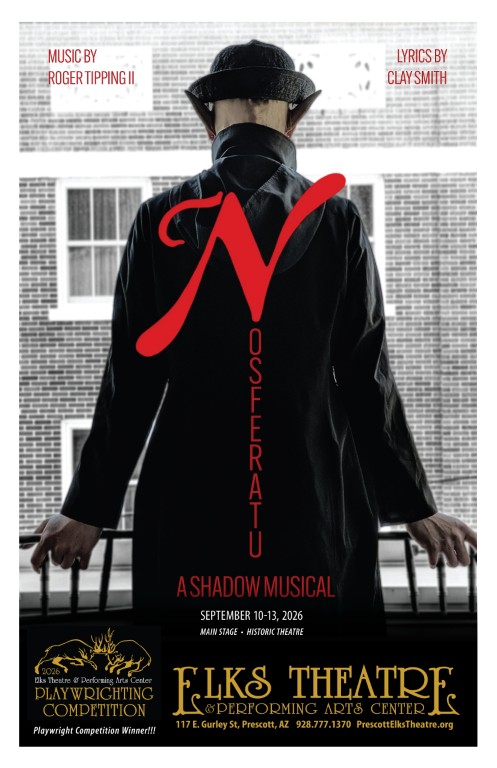
MORE THAN A CENTURY after Count Orlok first crept across the screen, one of silent cinema’s most unsettling figures is summoned back to life, this time with original songs, live dialogue and a distinctly Prescott sense of humor.
Roger Tipping II and Clay Smith will present the world premiere of Nosferatu: A Shadow Musical in the historic Elks Theatre. Winner of the Elks Playwriting Contest for 2026, the production combines live musical theatre with an edited take on the influential 1922 silent film Nosferatu: A Symphony of Horror. The result is neither a conventional screening nor a traditional stage musical.
Inspired in part by the shadow-cast tradition associated with The Rocky Horror Picture Show, actors will perform in front of the projected film, delivering new dialogue and original songs timed to the action taking place onscreen. New intertitles have also been created to support the narration, highlight important moments and add unexpected jokes.
A fresh approach
As far as Tipping and Smith know, a musical in this exact format has never been produced before.
The idea began with Smith’s interest in creating something new around a silent film. Because silent movies offer visual storytelling without recorded dialogue, they provide enormous freedom for writers to reinterpret characters, relationships and motivations.
Smith initially considered Fritz Lang’s Metropolis, but the collaborators shifted their attention to Nosferatu shortly before they began writing. Tipping had recently watched the film and could immediately see possibilities for reshaping its familiar story.
The original film, an unauthorized adaptation of Bram Stoker’s Dracula, follows an eager young estate agent whose journey to a remote Transylvanian castle unleashes terror upon his hometown. Although the musical retains that general narrative outline, Tipping and Smith have substantially transformed the characters and their individual journeys.
The creators are not simply adding modern jokes to an old movie. Their version mixes deliberately old-fashioned language with contemporary expressions, allowing characters to inhabit contrasting theatrical worlds. The elevated dialogue of one character might collide with the casual language of another, creating humor without completely abandoning the eerie atmosphere of the original film.
The music is equally central to the experiment. Tipping expects the finished production will include about 18 original numbers. Each song begins with a question: Why should a character sing at this moment?
Once the collaborators identify the dramatic purpose, they find a hook for the number. Smith drafts the lyrics, often remarkably quickly, and Tipping develops the musical theme at the piano. Together they reshape the words and music till both fit the characters and the movement of the film.
One song, “Ex Morte Vita,” takes its name from the Latin for “from death comes life.” It appears as a professor attempts to explain vampirism to characters living in a world where the idea is still unfamiliar.
Matching live music to a century-old film has required an unusual creative cycle. A scene inspires lyrics, the lyrics become a song, and the completed song is then placed back against the footage. The film may be shortened, extended or rearranged to make the theatrical moment work. Sometimes images and music align without deliberate planning.
During the writing process Tipping and Smith discovered that certain musical moments landed perfectly with movements in the film. Themes also began returning naturally. A short musical phrase originally written to represent a cuckoo clock unexpectedly fit the harmonic structure of the final number, allowing it to reappear near the end of the show. Those moments of creative coincidence have become part of the production’s identity.
A winning formula
Nosferatu: A Shadow Musical reached the Elks Theatre through its annual playwriting competition. Tipping and Smith submitted a completed but still developing script, hoping the strength of the concept and music would earn them a place among the finalists.
They were selected to present a ten-minute preview with four songs. The audience then voted on which of five competing works they most wanted to see produced in full, choosing Nosferatu.
The enthusiastic response gave the creators confidence that their strange combination of horror, comedy, silent film and musical theatre could connect with an audience. Tipping has been especially surprised by the interest shown by older Prescott theatergoers, many of whom have stopped him to ask about the production and when tickets would become available.
The project has also drawn together artists from across Prescott’s theatre community. The cast includes Alyssa Ebel, Molly McKee, and Hannah Palazzi along with Tipping and a talented ensemble. Janet Bontrager has joined the production as stage manager, with Patty Schaefer serving as assistant stage manager.
For Tipping and Smith the production has confirmed that their contrasting skills fit together naturally. Ideas are explored rather than guarded, and neither collaborator appears overly interested in defending creative territory. That willingness to experiment has allowed the show to, in their words, spiral “out of control in a fun way.”
With horror elements, adult humor and plenty of creative anachronisms, Nosferatu: A Shadow Musical promises a theatrical experience as unusual as its title suggests.
The show will play September 10–13 in the Elks Theatre, 117 E. Gurley Street, Prescott. Parental discretion is advised.


