

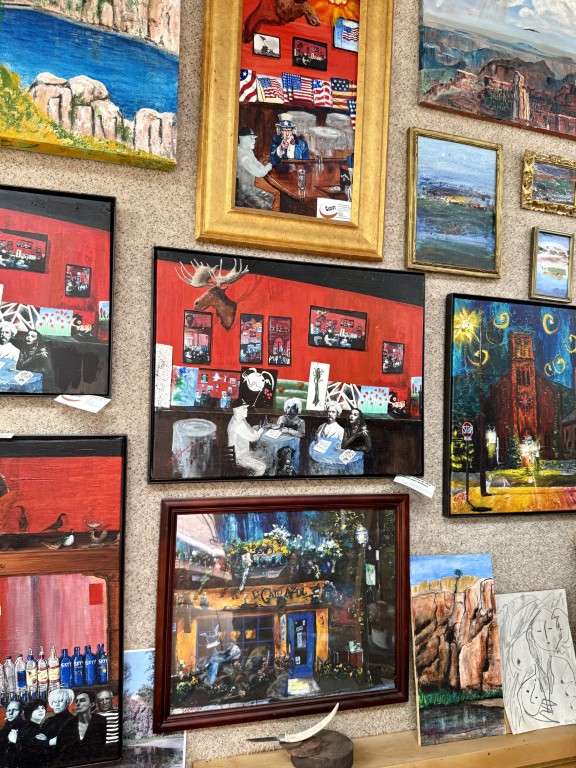



WE DON'T OFTEN THINK of the words ‘Army’ and ‘Artist’ in the same context, but Gary ‘Butch’ Cassidy has built a fulfilling and prolific artistic life on the foundation of thirty years in military service.
The Army artist
Retiring as a colonel, he had spent over twenty years as a psychological-operations specialist, ending his service as chief of the Army’s Psychological Operations and Civil Affairs Division at the Pentagon. In 1998, three months after retirement, he was recalled and appointed the Army’s official artist for six months, and deployed a second time to Bosnia for a little over a month. In the remainder of that six-month period he turned out three 40x30” paintings, one 30x25” painting and many drawings depicting Army activities he witnessed while deployed.
“I was extended by the Secretary of the Army for four months to complete a painting that recognized Native American and Alaskan Indian involvement in the first Gulf war. That painting was dedicated in a ceremony honoring the Code Talkers in 1999 at the Pentagon. My role was to come up with an idea for the painting and complete it. I decided on a collage depicting Army, Air Force, Navy and Marine Native Americans and Alaskan Indians performing military tasks as they might have done during the first Gulf war. I then presented my painting and got to say a few words about it to the Code Talkers during the ceremony. Let me tell you, it was an honor to meet those folks,” Cassidy said.
His military honors and artistic contributions are many, paving the way to his dream of retiring and making art in Prescott. Here he has not only created sculptures, paintings, stained-glass windows and assemblages, but he’s also served as board president of Friends of Yavapai College Art, where he taught metal sculpture and blacksmithing. He also served as executive director of the Phippen Museum of Western Art and as committee chair for arts and culture on the Mayor’s Advisory Committee on Prescott 2050 Visioning.
.jpg)
The collection
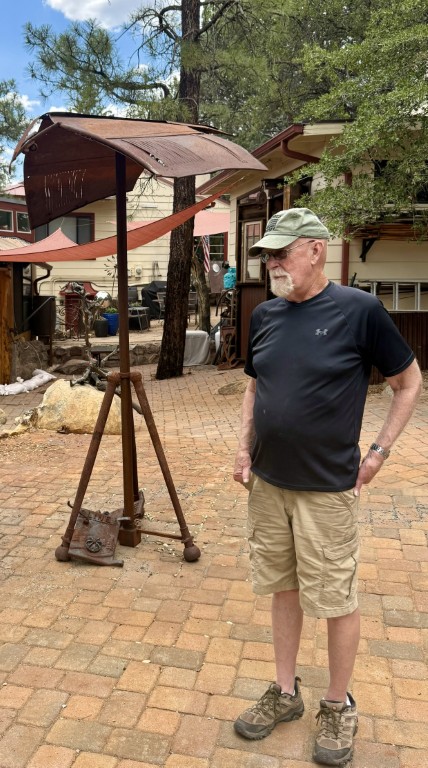
The list goes on, but what most engages him these days is envisioning his large and diverse collection of found and vintage objects into awe-inspiring works of art. “I collect things. I collect materials, objects and antiques, and when the vision hits, I repurpose them into my art, like the side of an armored personnel carrier that was used as a target on my machine-gun range, or the hood of a Model T that became an eight-foot-high winged sculpture I called Model T Bird. It’s always interesting to see what they will become,” Cassidy said.
The Prescott compound he shares with his wife Ali (recently retired from the VA job that brought them here, also involved in many artistic activities) and their dog and cats incorporates three remodeled houses, creating a private landscape. Studios spill into patios, patios meander into sculpture gardens, all surrounded by open space, trees and views of Prescott minutes from the Plaza. His prolific collections are semi-contained in multiple buildings incorporated onto boulders and woven together with metal art fencing perched on artistically arranged rock walls. The property is a work of art in itself.
In renovating one of the homes they acquired, Gary was working on clearing the basement of previous owners’ castoffs. “I finally got around to cleaning out under the basement stairs, which was really nasty. I pulled on this cardboard box and it turned to dust and inside was well over a hundred pounds of stained-glass pieces. I found out from people who’ve been working with stained glass for years that some of the pieces were colors not made anymore. I incorporate them into windows, cupboard doors and other things I design. It’s like building a puzzle.”
The author
Over twelve years Cassidy has written a trilogy of historical novels (‘mytho-memoirs’) about his life and times serving in the Army and Army Reserve for over thirty years. Volume I: A Soldier’s Story and Volume II: A Fisherman’s Story are available through Amazon, and Volume III: An Artist’s Story is in the final editing stage and will be available soon.
A Soldier’s Story looks back on Gary’s early Army service and his time living in Monterey, Carmel, Big Sur, and on Hunter Liggett Military Reservation in the early ‘70s. Interwoven throughout are flashbacks of his Vietnam wartime experiences, much as these flashbacks have occurred throughout his life. Volume I ends with Gary returning to college to study art in the late ‘70s and early ‘80s.
In A Fisherman’s Story, missing something in his life, he joins an Army Reserve unit and comes to the realization that he will always be Army. There are fishing adventures, from commercial salmon fishing out of Newport, Oregon to adventure training out of Wrightsville Beach, North Carolina on a charter fishing boat. (Ask him to tell you “The Fish Story” sometime, I wouldn’t do it justice.) The Artist’s Story covers how he was recalled from retirement and appointed the Army’s Artist for one more year of service. His many projects include one focusing on the military contributions of the Navajo Code Talkers and Inuit people.
These days Cassidy is doing frequent commissions, like a 7.5’ linear sculpture for Torme restaurant, an archway piece for the Highland Center’s amphitheater, and a recent 3x5’ stained-glass window for Trinity Church incorporating the found stained glass.
A special installation is a ‘she cave’ for his wife on her retirement from the VA. Below the house he constructed a beautiful art-filled room as an office, with a seating area beside large windows overlooking the wooded property, and a walk-through closet and dressing room.
The entire home is filled from top to bottom with remarkable works and installations, from massive tree-stump end tables to a floor-to-ceiling bathroom mosaic completed during the pandemic. There are military pieces, too, of course, many from found and antique objects shared with him over the years. From the looks of it Cassidy may never run out of material to spark his unlimited artistic imagination.


