
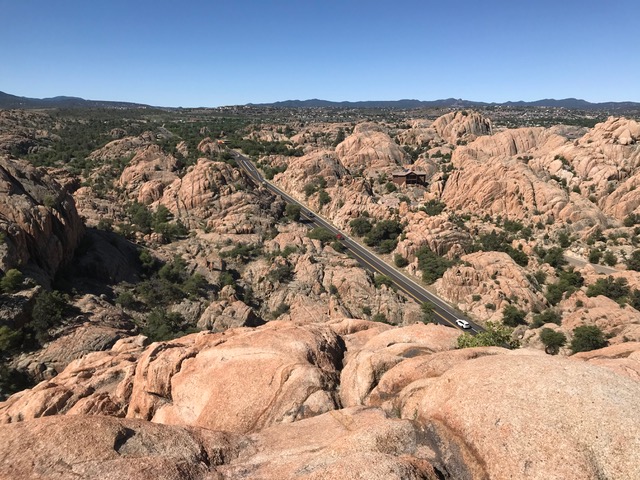
A memorable scene in the film Junior Bonner, featuring ‘60s movie icon Steve McQueen, took place on State Road 89 in the Granite Dells. In it we see McQueen’s Bonner driving through the Dells in his classic Cadillac convertible, pulling a horse trailer, as two couples in another convertible pull up adjacent and toss him a can of beer to welcome him to Prescott. The film, a tribute to the rodeo and Prescott, captures the beauty of the Dells as Bonner sleeps next to Watson Lake, then drives into town.
Many in Prescott consider the Dells emblematic of what makes the area unique in all the world. National Geographic named the stretch of 89 that runs through the Dells the “#1 Driver’s Drive in the World.” The Narrows is the short stretch between Boulder Creek and Twisted Trail.
So in 2023, when Prescott City staff proposed replacing an effluent line and simultaneously blowing up the distinctive granite rock to widen 89 to five lanes through the Narrows, hundreds of residents objected. The group Save the Dells attended Prescott City Council meetings to weigh in over several months. The City Council asked for a traffic study and further exploration of feasible options.
In June 2025 Prescott City staff, led by Director of Public Works Gwen Rowitsch, returned to Council with a plan narrowed to three options to address increasing traffic on the road. The options included a five-lane widening through the entire corridor ($36.7 million), a five-lane widening with a barrier in the narrow section ($35.5 million), and a no-widening alternative ($25.2 million for slip lanes and metering).
In tandem with this proposal, a traffic study was done by Kimley-Horn, an engineering consulting group with a local office. The group did a traffic count over one day while incorporating data from the AZ Department of Transportation, other traffic studies and a range of population studies from 2011 to 2022. Despite all that, many in the public expressed doubt about the validity of the data, for several reasons.
First, traffic studies are typically done over several days, and Kimley-Horn was required to do four counts over the various seasons. Second, the study assumes 2.75% annual traffic growth, far higher than past traffic growth of 1.5% and higher than the projection by the Central Yavapai Metropolitan Organization. Third, the study projected that two more roundabouts would be needed for feeder roads. The study counted a total of two cars that used those feeder roads at one of the proposed roundabout locations over the course of a day. If two more roundabouts were built, that would mean four roundabouts on two and a half miles of highway. To date no costs for roundabouts are included in any alternative proposed by staff.
Rowitsch pointed out during the June meeting that Arizona Eco Development, a home-construction company, plans to develop homes near the area, which could affect traffic on 89 in the future. Prescott Traffic Manager Ian Mattingly also said that he thinks 89 already has too much traffic, and the road would fall to a “D or E” grade (high congestion) by 2030. He pointed out the roughly 15,500 more homes already approved for construction in the area.
How did we get here?
The idea of widening the Narrows didn’t originate with the City, it was first proposed by CYMPO in 2011 as part of its work to plot long-term road planning for the region. CYMPO ranked it as a “medium” priority for 2030 or later if population growth continues at its annual 1.5% rate. Since CYMPO plans are broad options for future development that may or may not occur, the report wasn’t seen as a road map set in stone, so to speak.
It's not the first time CYMPO has plotted out a road that many in the public found to conflict with local priorities on open space and preserving local flora and fauna. The proposed Sundog Connector project also elicited a strong backlash from Prescott residents because it would have cut through a regional park that was recently established through a compact between Yavapai County, the City of Prescott and the Town of Prescott Valley. In addition it would have had little impact on Highway 69 traffic, which was meant to be the point of building it. That project has been shelved.
Too many issues to go forward
A parade of 14 speakers appeared before the City Council on October 14 to oppose any version of widening the Narrows. They cited a range of issues that not only involve flaws in the planning, but a lack of transparency related to the city’s centralization plan for sewer treatment. But the main objection is the same as in 2023: blowing up the Narrows is an unacceptable solution.
“Seventy percent of the public is against the widening,” said Mayor-elect Cathey Rusing.
Several members of the audience had run the 89 website’s public commentary through AI programs and found they showed much stronger public opinion against widening the Narrows than in favor of it.
Rusing also pointed out that the centralization plan, which was the entire impetus for planning sewer pipes under SR 89, was shrouded in mystery in terms of its ultimate cost and design, which made the problem a much larger one than just replacing one effluent pipe that keeps leaking. She asked Council to delay a vote on the construction project scheduled for October 28 because too many questions about the project hadn’t been answered. She also noted that the centralization-plan spending may violate the City’s Proposition-401 amendment, which limits how much Prescott can spend on a project without going to the public for approval.
Some speakers wondered whether traffic would be an issue in the future if an effort was made to put commercial development, with shopping, restaurants and medical services, in north Prescott. Mattingly had noted that only 46% of vehicles using 89 were work commuters.
Dottie Morris, president of the Granite Dells Preservation Foundation, said a past council made the poor decision to build the mall on Highway 69 for the tax revenue, spending at least $15 million of taxpayer dollars on roads and electrical infrastructure for the project. A mine atop Bullwhacker Hill was removed and the land flattened for the project, which has never panned out for generating long-term tax revenue. She emphasized that the area’s natural beauty is what makes it valuable.
“We hold that area as being a precious gem,” Morris said, urging Council to vote against the widening.
Bonnie McMinn, a resident who pushed for passage of a recent proposition to preserve public parks and prevent the City from selling land without voter approval, said that the process of public review had been bungled from the beginning. The city passed Resolution 2024-1876 to ensure transparency, accountability and a clear process before any vote, but didn’t follow its own rule requiring a 60-day public-comment period and release of the documents the public needs to see to evaluate the design project, she said.
The vote on the project was ultimately postponed till after the Mayor and three new Council members take their seats. The meeting will be held on November 18.


